Ein Koch macht einen Scherz – Doch was dann geschah, brachte das ganze Restaurant zum Schweigen“
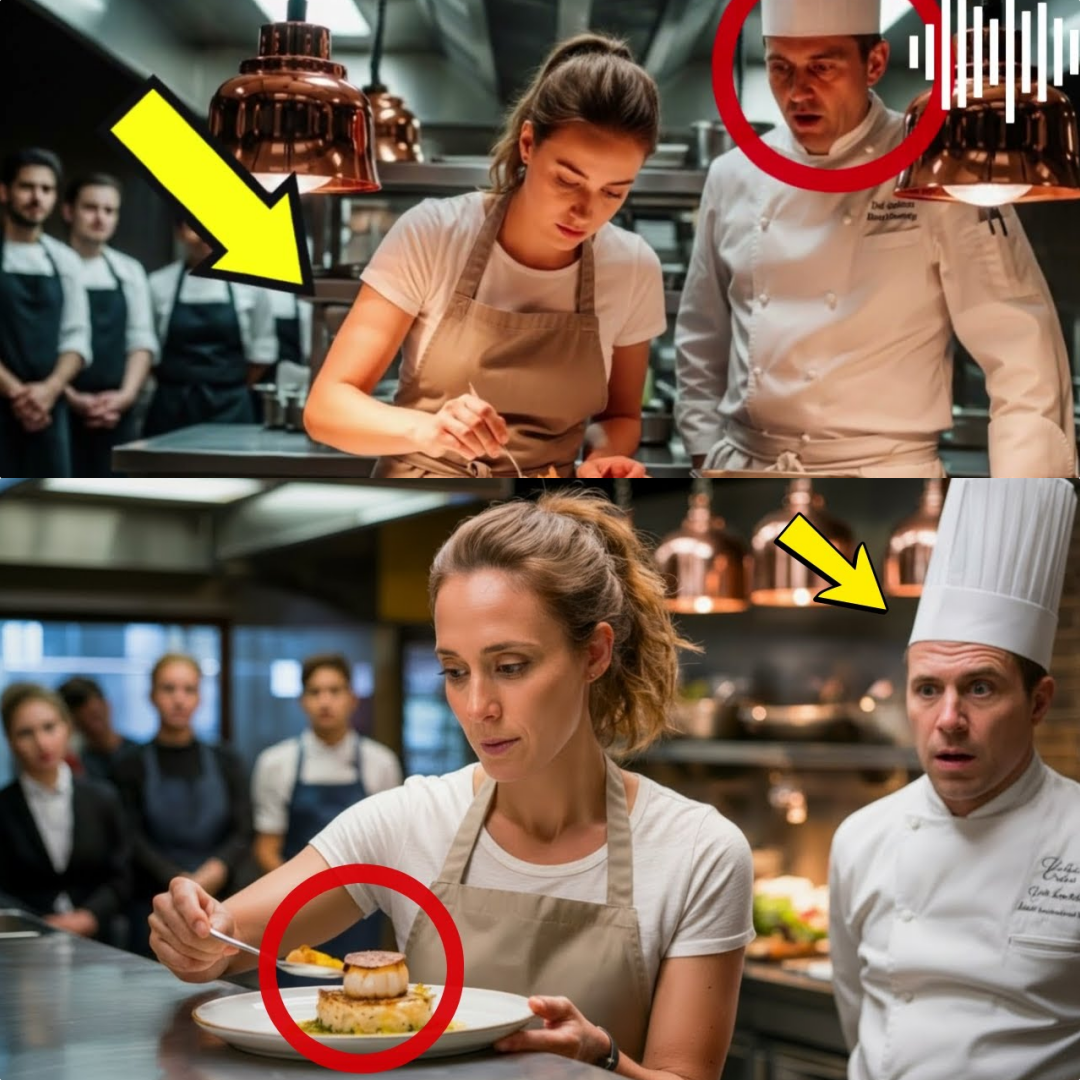
When chef Marcus Wellington told a simple woman to cook a dish as a joke, he never expected what happened next. What this humble cleaning lady created in that upscale kitchen didn’t just shock the whole restaurant. It changed everything they thought they knew about talent, dreams, and second chances. The copper pots gleamed like mirrors in the pristine kitchen of Wellington’s, one of the city’s most exclusive dining establishments. Steam rose from simmering sauces while the evening rush approached, and every
surface buzzed with the controlled chaos of fine dining. Rosen Patterson, roy to those who bothered to learn her name, pushed her cleaning cart between the stainless steel stations. At 38, she’d perfected the art of being invisible. Her blonde hair always pulled back in a practical bun, had started showing silver threads that caught the kitchen’s warm lights. The beige apron over her simple white t-shirt bore the stains of honest work. “Behind you,” called Tommy Rodriguez, the young sue
chef, carrying a tray of perfectly plated appetizers. He offered Rosie a quick smile, one of the few who treated her like a person rather than a fixture. Rosie had worked at Wellington’s for 3 years, arriving before dawn to prepare the kitchen for Chef Marcus Wellington’s empire. She knew every corner of this place, where the expensive truffle oil was stored, which burner ran hot, how the temperamental walk-in freezer door needed to be jiggled just right. But what nobody knew was how Ros’s heart
oed. Every time she smelled the herbs being chopped, every time she heard the sizzle of proteins hitting hot pans, it stirred memories of her grandmother’s kitchen in a small Pennsylvania boarding house where she’d learned to coax magic from simple ingredients. “Those were different times,” she’d whispered to herself, wiping down surfaces that already sparkled. Chef Wellington swept through the kitchen like a storm in pristine whites. His traditional chef’s hat adding to his
imposing 6-foot frame. [clears throat] His reputation for perfection was matched only by his legendary temper and disdain for anyone he deemed beneath his culinary kingdom. Patterson. His voice cut through the kitchen noise. You missed a spot on station 3 yesterday. This is a Michelin starred establishment, not some greasy diner. Rose’s cheeks burned, but she simply nodded. Yes, Chef Wellington. The evening service began, and Rosie retreated to her world of mops and sanitizer, watching the ballet of
professional cooking from the shadows. She knew every recipe by heart, having overheard the prep meetings for months. Her fingers itched to hold a knife properly, to feel the weight of a good pan, to create something beautiful. Eleanor Mitchell, a distinguished 70-year-old food critic and longtime patron, sat at table 12, her silver hair perfectly styled, her keen eyes missing nothing. She’d been coming to Wellington’s for years, watching careers bloom and crumble under the chef’s exacting
standards. Betty Crawford, the restaurant manager, moved through the dining room with practiced grace, ensuring every detail met the establishment’s impossible standards. She’d climbed her way up in the restaurant world when few women could, and she had no patience for weakness. As Rosie emptied trash bins near the pass, she caught fragments of the kitchen’s conversation. Tommy was struggling with the source reduction. His young face creased with concentration and fear. Not thick enough, Chef Wellington barked. Start
over. And this time, don’t embarrass me in front of the guests. Ros’s heart went out to the young man. [clears throat] She remembered her grandmother’s gentle guidance. Cooking ain’t about perfection, honey. It’s about love and patience. The dinner rush intensified. plates flying out of the kitchen like works of art. Rosie continued her invisible dance, cleaning and organizing her movements as precise as any chefs. Honed by years of watching and longing, she had no idea that everything was about to change. The
accident happened during the busiest moment of service. Rosie was reaching across station 4 to replace a sanitizer bottle when Tommy, rushing with a hot pan, bumped into her cart. The bottle tumbled, its contents splashing across Chef Wellington’s pristine workspace and soaking his prized mison place, the carefully arranged ingredients for his signature dish. The kitchen fell silent except for the hiss of burners. Every knife stopped chopping. Every spoon stopped stirring. Even the dishwashers

paused their endless clatter. Chef Wellington’s face turned the color of a ripe tomato. His pale blue eyes, usually cold as winter, now blazed with fury. The kitchen staff instinctively stepped back, knowing what was coming. “You clumsy fool,” he roared, his voice echoing off the copper pots. Do you have any idea what you’ve just destroyed? That was $20 worth of ingredients. This is why people like you belong with mops, not in a real kitchen. Ros’s hands trembled as she grabbed towels,
desperately trying to clean the mess. I’m so sorry, chef. I’ll replace everything. I’ll replace it. Wellington’s laugh was bitter and cruel. With what? your cleaning lady salary. This is precision work, something you wouldn’t understand in a million years. The dining room conversations had stopped. Guests craned their necks, drawn by the commotion. Elleana Mitchell sat down her wine glass, her experienced eyes narrowing with disapproval at the public humiliation unfolding. Betty Crawford appeared in the kitchen
doorway, her professional smile masking concern. Chef, perhaps we should know. Wellington’s voice rose even higher. Everyone needs to see what happens when unqualified people interfere with art. This woman thinks she can waltz around my kitchen like she belongs here. [sighs] Tommy shifted uncomfortably, guilt written across his young face. He opened his mouth to speak, but fear silenced him. Jobs at Wellington’s were coveted. Crossing the chef meant career suicide. Rosie straightened slowly, her cheeks
burning with shame, but something else flickering in her green eyes, something that hadn’t been there in years. Her grandmother’s voice echoed in her memory. Don’t let anyone make you feel small, Rosie girl. You’ve got gifts they can’t even imagine. I understand cooking better than you think,” she said quietly, her voice barely audible above the kitchen’s mechanical hums. Wellington’s eyebrows shot up in mock surprise. “Oh, really? Our cleaning lady is a culinary expert
now. This just keeps getting better.” The cruelty in his voice sparked something deep within Rosie. 38 years of being overlooked, dismissed, and made invisible, crystallized into a moment of unexpected courage. “I’ve been watching this kitchen for 3 years,” she continued, her voice growing stronger. “I know every recipe, every technique, every mistake that gets covered up before it reaches the dining room.” The chef’s laughter was sharp and mocking. Watching? Oh, this is rich. You
think watching makes you a chef? I spent years training in Paris, working under masters you’ve never heard of. I’ve earned my place here. Then prove it, Rosie said, the words tumbling out before she could stop them. Let me cook something. If I fail, I’ll quit tonight and save you the trouble of firing me.” The kitchen erupted in whispers. Never in Wellington’s history had anyone challenged the chef like this, especially not a cleaning lady. Wellington’s eyes glittered with
malicious delight. Here was his chance to humiliate her completely, to make an example that would keep everyone else in line. “Fine,” [snorts] he said, his voice dripping with condescension. “Cook me something, anything. When you fail, and you will fail spectacularly, everyone will see exactly where you belong, and then you’re gone. Elena Mitchell leaned forward in her chair, intrigued despite herself. In 40 years of restaurant reviewing, she’d never witnessed anything quite like
this. The gauntlet had been thrown. There was no turning back now. Ros’s hands stopped trembling as she walked to the prep station. The kitchen remained frozen in anticipation, but inside her mind, she was 8 years old again, standing on a wooden crate beside her grandmother’s old gas stove. “Remember, honey?” Grandma Rose’s voice whispered across the decades. “Cooking ain’t about fancy techniques or expensive ingredients. It’s about understanding what food wants
to become, then helping it get there with love.” Chef Wellington crossed his arms, his smile predatory. “Well, we don’t have all night, or are you already regretting your little outburst?” Rosie closed her eyes for a moment, letting the familiar sounds of the kitchen wash over her. When she opened them, something had changed. The frightened cleaning lady was gone, replaced by someone who remembered what it felt like to create. What ingredients can I use? She asked, her voice steady. Oh, how generous of
me. Wellington sneered. You can use whatever’s in the walk-in. Basic ingredients only. No truffles, no imported items. Let’s see what magic you can work with peasant food. Tommy watched nervously as Rosie made her way to the walk-in cooler. He wanted to help to somehow make up for his role in starting this disaster, but he didn’t dare move under Wellington’s watchful glare. Inside the cooler, Rose’s trained eyes, honed by years of inventory and cleaning, quickly cataloged what was
available. Chicken thighs, root vegetables, herbs that were past their prime for fine dining, but still full of flavor. Her grandmother had taught her that the best meals came from making something wonderful out of whatever you had. She emerged with her arms full, and the kitchen staff watched in fascination as she began to work. Her movements were different now, purposeful, confident, she selected a heavy bottomed pot, checking its weight like an old friend. This should be good, Wellington muttered to Betty, who had remained in
the kitchen doorway. Watch her burn everything and make a fool of herself. But as Rosie began to prep, something unexpected happened. Her knife work, while not as flashy as the trained chefs, was clean and efficient. She’d learned from watching, yes, but also from muscle memory that went back 30 years. She started by breaking down the chicken, her hands moving with quiet competence. The sound of her knife on the cutting board was rhythmic, almost meditative. She separated the skin, [clears throat]
cut the thighs into precise portions, and set the bones aside for what everyone assumed was waste. “She’s making chicken and vegetables,” one of the line cooks whispered. “Basic stuff my grandmother could do.” But Elellanena Mitchell, watching from the dining room, noticed something the kitchen staff missed. Ros’s technique might be simple, but her approach was that of someone who truly understood ingredients. The way she smelled the herbs before chopping them, how she tested the
chicken’s texture with her fingertips. These were the actions of an intuitive cook. Rosie heated the pot until it was properly hot, then began browning the chicken pieces skin side down. The sizzle was perfect, and the aroma that began to fill the kitchen was rich and promising. “Lucky guess on the temperature,” Wellington said dismissively, but his voice carried less certainty than before. As the chicken browned, Rosie prepared her vegetables with quiet precision. Carrots cut on the bias, onions in
perfect dice, celery sliced thin. She moved around the station like she belonged there, reaching for what she needed without hesitation. Grandma, she whispered so quietly that only she could hear. “Help me show them what we learned together.” The [snorts] chicken bones went into a small pot with water, herbs, and vegetable scraps. Wellington scoffed, but Rosie ignored him. She knew what she was building. something that would take time but would be worth the wait. The real test was about to begin.
[clears throat] Steam rose from Rosy’s pot as she carefully removed the perfectly golden chicken pieces, their skin crackling with promise. The kitchen had fallen into an unexpected rhythm around her work. Staff members finding excuses to walk past her station. She’s not completely hopeless,” Tommy whispered to another line cook, earning a sharp look from Chef Wellington. Rosie began building her sauce in the same pot, using the brown bits left behind by the chicken, she added her diced vegetables, listening to
the gentle sizzle that told her the temperature was just right. Her grandmother’s voice guided every move. “Let the food talk to you, honey. It’ll tell you what it needs.” The aromatics filled the kitchen with a warmth that had nothing to do with the heat from the stoves. Even the hardened blind cooks found themselves unconsciously taking deeper breaths. “She’s making a basic braise,” Wellington announced loudly, trying to regain control of the narrative. “Nothing special about that. Any
culinary school dropout could manage it.” But his words carried less conviction than before. Ross’ movements had a quiet confidence that spoke of deep understanding rather than mere technique. When she added wine to delays the pot, she did it with the patience of someone who knew that rushing this step would ruin everything. The quick stock she’d started from the chicken bones was already beginning to develop color and depth. She strained it through a fine mesh, then added it to her pot along with the brown chicken.
The liquid came to a gentle simmer, and she adjusted the heat with the precision of someone who understood that cooking was about time and temperature working in harmony. “How long have you been cooking?” Betty asked, unable to hide her curiosity. “30 years,” Rosie replied, simply never taking her eyes off the pot. “Just not professionally.” Eleanor Mitchell had quietly moved closer to the kitchen, drawn by the unfolding drama and the incredible aromomas beginning to waft through the
restaurant. Other diners were starting to notice, too. Conversations turning to speculation about what was happening behind the scenes. Rosie tasted her developing source with a clean spoon, her expression thoughtful. She reached for the herb box, selecting fresh thyme and rosemary with the care of someone choosing jewelry. But instead of chopping them, she bruised them gently between her palms before adding them to the pot. “Why didn’t you mince those?” asked one of the younger cooks, genuinely curious.
“Because I want them to release their oil slowly,” Rosie explained patiently. If you chop them too fine too early, they’ll lose their brightness during the long cooking. Wellington’s jaw tightened. The explanation was not only correct, but showed a deeper understanding of flavor development than many of his trained staff possessed. As the brace simmered, Rosie turned her attention to what would become the final element of her dish. She took the reserved chicken skin and began cutting it into thin strips with
mathematical precision. What’s she doing now? Tommy wondered aloud. Rosie heated a clean pan until it was hot but not smoking, then carefully placed the skin strips down. They began to render slowly, filling the kitchen with an aroma that made everyone’s mouth water. [snorts] She wasn’t just cooking. She was creating something that spoke to the soul. Chicken cracklings, she said simply when she noticed the staff watching. My grandmother always said that wasting good chicken skin was a sin against
nature. The strips turned golden and crispy, and Rosie drained them on paper towels, sprinkling them with just a touch of sea salt while they were still warm. Wellington checked his watch dramatically. How much longer is this charade going to take? We have paying customers waiting. But his protest rang hollow. The entire kitchen had been drawn into Ross’ quiet magic, and even he couldn’t deny the incredible smells coming from her station. 45 minutes after the humiliation began, Rosie lifted the lid from her pot. The
aroma that escaped was so rich and complex, the conversation in the dining room actually stopped. The chicken had transformed into something that glistened with deep mahogany colored sauce. The meat so tender it was falling off the bone. “Dear Lord,” whispered one of the line cooks, “that smells like my childhood.” Rosie began plating with the same quiet confidence she’d shown throughout the cooking process. She arranged the chicken on a simple white plate, then spooned the glossy sauce around it,
making sure each portion received vegetables that had absorbed all the complex flavors of the braise. Finally, she scattered the crispy chicken skin cracklings across the top like golden confetti, adding both texture and a final aromatic flourish that made several staff members actually gasp. There,” she said simply, wiping her hands on her apron. “It’s ready.” The kitchen fell silent, except for the usual sounds of service. Chef Wellington approached the plate like a man walking
to his execution, his usual swagger replaced by something that looked almost like fear. He took the fork that Rosie offered and cut into the chicken. The meat yielded like butter, and the sauce clung perfectly without being heavy. He raised the bite to his mouth, and everyone in the kitchen held their breath. The change in Wellington’s expression was subtle, but unmistakable. His eyes widened slightly, then closed as he chewed slowly, deliberately. When he opened them again, the arrogance was
gone, replaced by something that looked like recognition. “How?” he asked quietly, his voice stripped of its earlier mockery. “My grandmother,” Rosie replied. “She ran a boarding house in a small town up north, cooked for 30 people every day with whatever she had. She taught me that food is about more than technique. It’s about understanding what people need, not just what they want.” Elana Mitchell had somehow made her way into the kitchen without anyone noticing.
Now she stood beside the pass, her experienced pallet analyzing every nuance of aroma coming from the plate. “May I?” she asked Wellington, who was still staring at Rosie as if seeing her for the first time. He handed [snorts] her a clean fork without protest. Eleanor took a small bite, chewed thoughtfully, then closed her eyes with an expression of pure pleasure. “This is extraordinary,” she said softly. It tastes like memory, like comfort, like coming home after being away too
long. Tommy stepped forward, no longer able to contain his curiosity. Chef Wellington, can I? Wellington nodded absently, still processing what had just happened. Tommy tasted the dish, and his young face lit up with amazement. This is better than anything we serve,” he said, then immediately looked terrified at his honesty. But Wellington didn’t explode. Instead, he looked at Rosie with something approaching respect. “Where did you learn to balance flavors like this? This isn’t just home
cooking.” “This is sophisticated technique hidden in simple presentation. I’ve been watching your kitchen for 3 years,” Rosie said. But my foundation came from my grandmother. She never went to culinary school, but she understood that cooking is about transformation, taking ordinary things and making them extraordinary through patience and love. Betty Crawford tasted the dish and shook her head in wonder. This would sell out every night if we put it on the menu. The words hung in
the air like a challenge to everything everyone thought they knew about talent, training, and who belonged in a professional kitchen. Wellington looked around at his staff, all of whom were staring at Rosie with new eyes. Then he looked at the plate again at this simple dish that had somehow captured something his technically perfect cuisine often missed. I owe you an apology, he said quietly. But Rosie was about to show him that this was just the beginning. The kitchen remained suspended in stunned silence as Chef Wellington
struggled with words that had never crossed his lips before. Around them, the dinner service continued. But something fundamental had shifted in the heart of the restaurant. “I was wrong,” Wellington said finally, his voice carrying none of its earlier arrogance. “Completely, utterly wrong.” He turned to face the kitchen staff, many of whom had never seen their imperious chef display anything resembling humility. “This woman has just taught all of us something about cooking that I
apparently forgot somewhere along the way,” he continued. “Tique is nothing without soul. Precision means nothing without understanding.” Rosie stood quietly, still processing what had just happened. In 45 minutes, she had gone from invisible cleaning lady to someone who had commanded the respect of one of Manhattan’s most demanding kitchens. Eleanor Mitchell stepped forward, her silver hair catching the kitchen lights. Rosie, may I call you Rosie? I’ve been reviewing restaurants for 40 years. What
you just created wasn’t just a dish. It was a story. It had a beginning, middle, and end. It had emotion. She paused, looking directly at Wellington. It had something that many technically perfect dishes in expensive restaurants lack. It had heart. [snorts] Wellington nodded slowly, the weight of her words clearly hitting home. Rosie, I need to ask you something, and I’ll understand if you tell me to go to hell after how I treated you. The kitchen held its collective breath. Would you consider working here? Really
working here? Not as a cleaner, but as a cook. I think no, I know you have things to teach all of us. Tommy’s face broke into a grin, and [clears throat] several other staff members nodded enthusiastically. Betty Crawford was already calculating how to restructure schedules and positions. Rosie looked around the kitchen that had been her workplace for 3 years, but which she was seeing now through completely different eyes. These weren’t just colleagues anymore. They were people who had witnessed her
transformation and embraced it. I’m 38 years old, she said slowly. I never went to culinary school. I don’t know all the French terms or the classical techniques. Neither did Julia Child when she started. Elellanena interjected with a smile. Neither did so many of the great cooks throughout history. What you have can’t be taught in school. It has to be lived. Wellington extended his hand to Rosie. I was taught that cooking is about domination. Dominating ingredients, dominating techniques, dominating other
people. You’ve just shown me that real cooking is about collaboration with the food, [clears throat] with the process, with the people you’re feeding. Rosie looked at his outstretched hand. Then at the faces surrounding her, she thought about her grandmother, who had always believed that everyone deserved a chance to shine, no matter where they came from or how long it took them to find their path. “Okay,” she said simply, shaking his hand. “But I do things my way. No more
humiliating people. No more making anyone feel small. A kitchen should be a place where people grow, not where they get broken down.” Wellington nodded and for the first time in a years his smile was genuine. “Deal,” he said. “Welcome to the team, Chef Patterson.” The kitchen erupted in applause, and Rosie felt tears she didn’t know she’d been holding back begin to flow. “Sometimes the most important journeys begin with a single brave step. What did you think of Ros’s incredible
transformation? Have you ever felt overlooked or underestimated because of your background or circumstances? Sometimes our greatest talents are hiding just beneath the surface, waiting for the right moment to shine. Hit that subscribe button if you believe everyone deserves a chance to show their true potential. And let me know in the comments where you’re watching from. I love hearing from viewers around the world. Share the story with someone who needs to remember that it’s never too late to pursue your dreams.
What other inspiring stories would you like to see? Let me know below. And remember, your story matters.