When Glenn Ford Challenged John Wayne’s Gun Skills — The Philosophy Lesson That Silenced Hollywood
When Glenn Ford Challenged John Wayne’s Gun Skills — The Philosophy Lesson That Silenced Hollywood

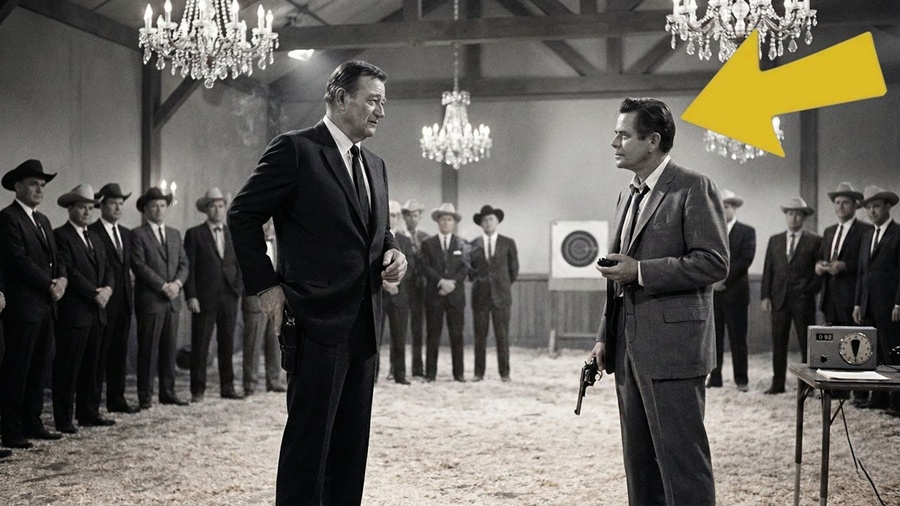
Paramount Studios, Los Angeles, March 1964. The commissary building’s west wing has been converted into an elegant reception hall for the evening’s Western Heritage Awards ceremony. Crystal chandeliers cast golden light across polished wood floors where Hollywood’s greatest western stars mingle in formal attire.
The air carries the scent of leather holsters, expensive cologne, and the weight of masculine authority. In one corner, Glenn Ford demonstrates his lightning fast draw to an impressed circle of producers and directors. 30 feet away, John Wayne sits at the bar, nursing a whiskey, watching with the patient eyes of a man who has seen this show before.
What happens next will settle a question that has lingered in Hollywood for 15 years. Is speed more important than substance? Quick question for you. Have you ever watched someone show off a skill only to see a master quietly demonstrate the difference between technique and mastery? Drop your state in the comments below.
And if this story interests you, hit that subscribe button for John Wayne Legacy Stories. We’re uncovering the moments that shaped the Duke’s character. Glenn Ford is 48 years old, one of Hollywood’s most accomplished actors, 25 years in the business with standout performances in Gilda, The Big Heat, and 310 to Yuma.
Ford has built a reputation as a serious professional who brings technical precision to every role. But tonight, he’s not discussing acting technique. He’s showing off the skill he’s most proud of. His gun draws speed. John Wayne is 57 years old, 35 years in Hollywood. The undisputed king of westerns with over 60 films in the genre.
Wayne doesn’t just play cowboys. In the minds of millions of Americans, he is the cowboy, the embodiment of frontier justice. moral certainty and the belief that character matters more than technique. The Western Heritage Awards ceremony draws every major star who has ever worn spurs on screen.
Tonight’s gathering includes veteran actors, rising stars, directors, and studio executives. It’s part awards show, part industry networking event, part celebration of the western genre that built Hollywood’s fortune. Ford holds court near the bar’s eastern wall where a makeshift demonstration area has been cleared. He’s wearing a perfectly tailored black suit with a leather gun belt around his waist.
The holster contains a prop colt45 specially modified for quick draw competitions. Ford has been practicing fast draw for eight years, ever since working with legendary gunfighter instructor Arvo Ojala on 310 to Yuma. The key, Ford explains to his captivated audience, is the grip. Most actors grab the gun like they’re shaking hands. Wrong.
You need to position your fingers precisely. Trigger finger along the frame, thumb on the hammer. He demonstrates the proper grip without drawing. muscle memory. Thousands of repetitions until it becomes instinct. The circle around Ford includes director George Stevens, producer Walter Mirish, and actors Randolph Scott and Joel McCrae.
They listen with professional interest as Ford breaks down the mechanics of fast draw technique. Speed is everything in a real gunfight, Ford continues. History shows us that the fastest gun wins. Wild Bill Hickok, Wyatt Herp. They weren’t the most accurate shooters. They were the fastest.
Dead accurate doesn’t matter if you’re already dead. Someone in the crowd asks for a demonstration. Ford smiles, steps back to give himself room, and assumes the classic gunfighter stance. Feet shoulderwidth apart, right hand hovering inches above his gun grip, left hand clear of his body. Time me, he says.
Director George Stevens raises his stopwatch. Ready now. Ford’s hand moves like lightning. The gun clears leather, rises to hip level, and his thumb the hammer in one fluid motion. The metallic click echoes through the reception hall. Stevens checks his stopwatch. 4 seconds. Stevens announces. Impressive. The crowd murmurs appreciation for it holsters the weapon with satisfaction.
Not bad for an old man, but I’ve done it in.35. That’s competition level speed. John Wayne has been watching this performance from his position at the bar. He hasn’t moved, hasn’t spoken, hasn’t acknowledged the demonstration, but his presence is felt by everyone in the room. When John Wayne is in a space, people are aware of him, even when he’s silent.
Ford notices Wayne’s attention and walks over, still wearing his gun belt. Duke, what do you think? Pretty good for someone who never claimed to be a real gunfighter. Wayne takes a slow sip of his whiskey before responding. Impressive, Glenn. You’ve put in the work, 8 years of practice. Work with the same instructor who trained Hugh O’Brien for the life and legend of Wyatt Herp.
He says, “I’m fast enough to have been a real gunfighter in the Old West.” Wayne nods thoughtfully. “Might be right about that.” Ford senses an opportunity. He’s always respected Wayne, but has never understood the mystique that surrounds him. Ford believes in measurable skills, quantifiable abilities. Wayne’s reputation seems based on intangibles that Ford finds difficult to grasp.
What about you, Duke? Every time your draw, Wayne considers the question. Can’t say I have. Really? With all the westerns you’ve made, all the gunfight scenes, I’d think you’d want to know how fast you are. Never seemed important. Ford looks puzzled. But speed is everything in a gunfight. The fastest gun wins. That’s historical fact.
Wayne sets down his whiskey glass and looks directly at Ford. Is it? The conversation has attracted attention from nearby guests. A small crowd begins to gather around Wayne and Ford, sensing an interesting exchange between two masters of the western genre. Absolutely. Ford continues. I’ve researched this extensively. Wild Bill Hickok, Batmasterson, Wyatt Herp, they all survived because they were faster than their opponents.
Wayne stands slowly, his full height commanding immediate respect from everyone present. At 6’4, he towers over most of the room. But it’s not his physical size that dominates. It’s the quiet authority he carries, the moral weight that seems to settle on his shoulders like a familiar coat. Glenn, can I ask you something? Of course.
In all your research about famous gunfighters, did you ever come across any who missed their target? Ford frowns, not understanding the direction of Wayne’s question. Miss, what do you mean? I mean, did any of these fast row artists ever lose a gunfight because they drew quick but shot wide? The crowd is now completely focused on Wayne.
Even Ford realizes that he’s being led somewhere he didn’t expect to go. Well, yes. I suppose some of them missed under pressure. Wayne nods slowly. See, that’s where I think your research might be incomplete. The fastest gun doesn’t always win. The most accurate gun wins. Speed without accuracy is just movement. Dangerous movement.
Ford’s confidence begins to waver. This isn’t the conversation he expected. But Duke accuracy doesn’t matter if the other guy shoots first. Wayne’s expression doesn’t change, but something shifts in his posture. He’s no longer just participating in a casual conversation. He’s teaching a lesson. Glenn, what’s the most important part of any gunfight? Drawing fast.
Before that, Ford looks confused. I don’t understand. Wayne’s voice drops lower, carrying the authority of 35 years playing men who lived by the gun. The most important part of any gunfight is not being in one. Real gunfighters, the ones who lived long enough to become legends, they didn’t look for fights. They avoided them when possible.
And when they couldn’t avoid them, they didn’t rely on speed. They relied on being right. The room has gone completely quiet. Wayne continues, his words carrying the weight of every western hero he’s ever portrayed. Wild Bill Hickok didn’t survive because he was fast. He survived because he was careful.
Wyatt Herp didn’t win at the OK Corral because he outdrew the cowboys. He won because he was fighting for law and order against men fighting for chaos. The righteousness of his cause steadied his hand. Ford tries to respond, but Wayne isn’t finished. Speed is a technique, Glenn. Accuracy is a discipline. But both of those are just tools.
What matters is the man using them, his character, his judgment, his willingness to use force only when it serves justice. Wayne walks over to the demonstration area where Ford had been showing off his quick draw. The crowd follows, understanding that something significant is happening. You want to know why I never timed my draw? Ford nods, genuinely curious now.
Wayne looks around the room, making eye contact with directors, producers, fellow actors, men who have made fortunes telling stories about the American West. Because the speed of your draw doesn’t matter if you don’t know when to draw. And you don’t know when to draw unless you understand what’s worth fighting for. Wayne’s voice fills the reception hall, carrying to every corner, despite never rising above conversational level.
Every gunfight scene I’ve ever done, every western I’ve ever made, it’s not about how fast I can pull a gun. It’s about why I’m pulling it. To protect the innocent, to uphold the law, to defend what’s right against what’s wrong. The gun is just a tool. The man behind it, his principles, his courage, his willingness to sacrifice for others.
That’s what wins or loses the fight. Ford stares at Wayne, beginning to understand that he’s been schooled by a master. Not in technique, but in philosophy. Wayne has just demonstrated that there are levels to expertise that can’t be measured with a stopwatch. Wayne walks back to the bar, picks up his whiskey, and takes a slow sip.
The crowd remains where they are, absorbing what they’ve just heard. Finally, Ford speaks. Duke, would you would you be willing to demonstrate your draw? Wayne considers the request. Then he sets down his glass and walks back to Ford. You still wearing that gun belt? Yes. Mind if I borrow it? Ford unbuckles the gun belt and hands it to Wayne.
Wayne straps it around his waist with the casual familiarity of a man who has worn guns in dozens of films. But something is different. This isn’t an actor putting on a costume. This is John Wayne accepting the weight of responsibility that comes with carrying a weapon. Wayne positions himself in the demonstration area.
But instead of assuming the classic fast draw stance that Ford demonstrated, Wayne stands naturally relaxed, his right hand hanging loose at his side. George. Wayne calls to director George Stevens. You still got that stopwatch? Ready when you are, Duke. Wayne doesn’t assume a gunfighter stance, doesn’t position his feet or clear his left hand.
He simply stands like John Wayne, looking directly at an imaginary opponent. Now, Stevens calls. Wayne’s movement is different from Ford’s lightning quick draw. It’s smooth, deliberate, controlled. The gun comes out of the holster like it’s being drawn by gravity rather than speed. Wayne brings it to chest level, aims down the barrel at an imaginary target, and holds the position steady as a rock.
Stevens checks his stopwatch. 8 seconds, twice as slow as Ford’s best time, but nobody in the room is thinking about speed. They’re looking at Wayne’s stance, his control, the unwavering steadiness of his aim. If this were a real gunfight, Ford might have cleared leather first, but Wayne would have hit his target.
Wayne holsters the gun and removes the belt, handing it back to Ford. Thank you. Ford takes the belt with newfound respect. Duke, I I think I understand what you’re saying, Wayne nods. Speed is impressive, Glenn, but accuracy is deadly, and character is what determines whether that deadliness serves justice or feeds chaos. The reception continues around them, but the dynamic has permanently shifted.
Ford no longer demonstrates his quick draw for the remainder of the evening. Instead, he engages Wayne in conversation about the responsibility that comes with portraying gunfighters on screen. Years later, Ford tells interviewers about the night John Wayne taught him the difference between technique and mastery.
I was proud of how fast I could draw a gun. Duke showed me that the question isn’t how fast you can draw. The question is whether you should draw at all. The 1964 Western Heritage Awards ceremony becomes legendary among industry insiders. Not because of the awards presented, but because of the lesson taught. Two accomplished actors demonstrated two different approaches to their craft.
Ford showed technical proficiency. Wayne showed moral authority. Glenn Ford continues to practice fast draw, but he changes his approach to western roles. His later performances emphasize character development over action sequences. He credits Wayne with teaching him that the most important battle a gunfighter faces isn’t against another gun.
It’s against his own temptations to use power without wisdom. John Wayne’s impromptu demonstration at the Paramount Commissary becomes part of Hollywood legend. Not because of his speed, he was measurably slower than Ford, but because of what his performance represented. Control over technique, substance over style, principle over prowess.
The lesson Wayne taught that night extends far beyond gunfights or western movies. It’s about the difference between having power and knowing how to use it responsibly. Ford had perfected a skill. Wayne had mastered a philosophy. In a business built on image and performance, Wayne consistently demonstrated that authenticity matters more than technique.
That moral authority trumps technical ability. That character, not capability, is what separates heroes from mere gunfighters. If this story moved you, hit that subscribe button for John Wayne Legacy Stories. We’re exploring the moments that shape the Duke and the lessons they hold for us today. When have you learned that mastery isn’t about speed or skill, but about wisdom and character? Real strength isn’t about how quickly you can act.
It’s about knowing when action serves justice and when restraint serves wisdom.