They Booed Bob Dylan for 15 Minutes Straight — Johnny Cash’s Response Silenced Them All
They Booed Bob Dylan for 15 Minutes Straight — Johnny Cash’s Response Silenced Them All
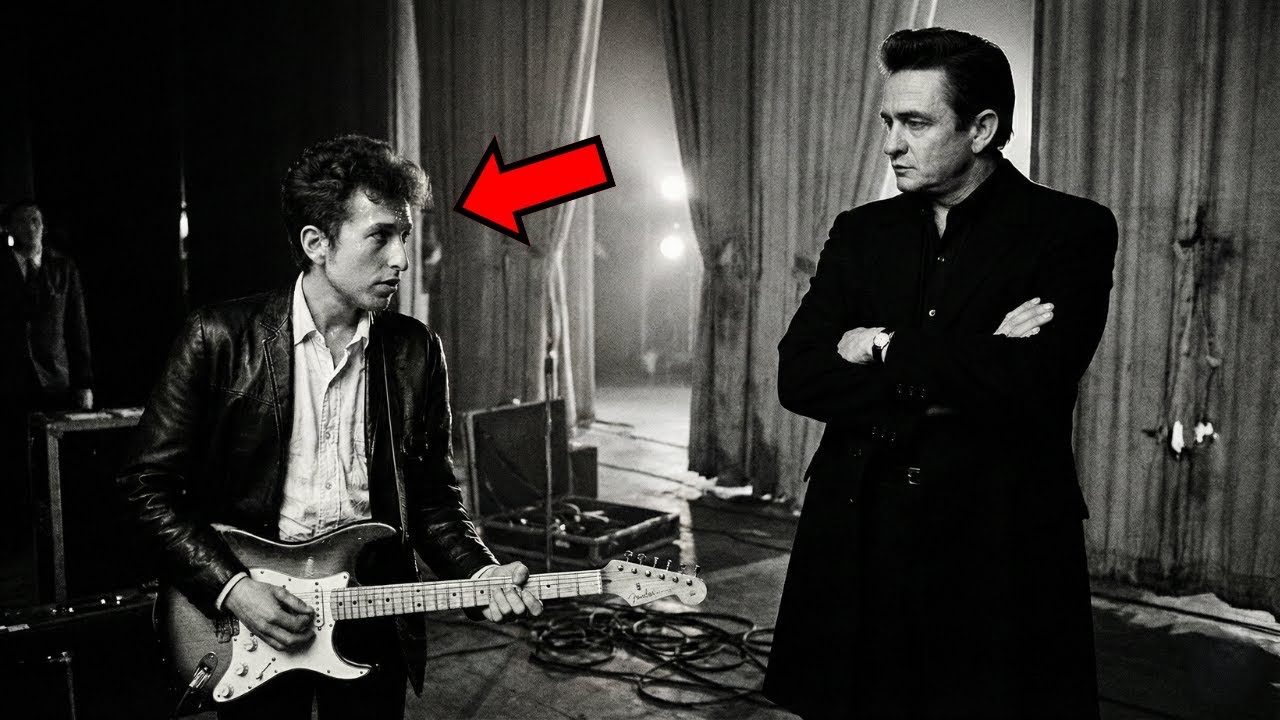
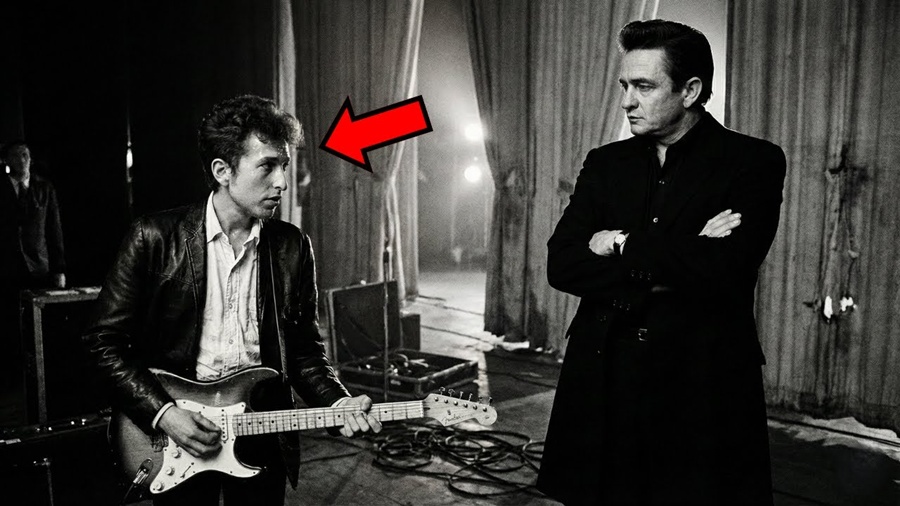
[music] July 25th, 1965, Newport Folk Festival. The moment Bob Dylan plugged in his electric guitar, 17,000 people held their breath. Nobody knew it yet, but they were about to witness the most controversial 15 minutes in music history. And backstage, watching from the shadows, stood one man who would change everything that happened next.
His name was Johnny Cash. But this story doesn’t begin on that stage. It begins three days earlier in a hotel room in Providence, Rhode Island, where two men who had never met face to face were about to have a conversation that would define both their legacies forever. July 22nd, 1965. The Builtmore Hotel, room 714.
Johnny Cash sat on the edge of the bed, still wearing his black coat despite the summer heat. He’d been awake for 36 hours straight, not because of the pills this time, but because of a phone call he’d received that morning. Bob Dylan was in trouble, real trouble, the kind that could end a career before it truly began.
Cash had heard the rumors swirling through the folk community like poison. Dylan was planning something for Newport, something that would betray everything the movement stood for, something unforgivable. The old guard was already sharpening their knives. Pete Seager, the godfather of folk music, had been overheard saying that if Dylan went through with it, he would personally see to it that the young singer never performed at Newport again.
Alan Lomax, the legendary musicologist, called Dylan a traitor to his own generation. Even Joan Bayz, Dylan’s former lover and champion, had grown distant and cold. Cash pulled out a crumpled letter from his coat pocket. He’d read it so many times the paper was wearing thin at the folds. It was from Dylan, received just two weeks ago.
The handwriting was messy, almost frantic. Johnny, they want me to be something I’m not. They want me to be their voice, their prophet, their spokesman for a generation. But I’m just a singer. I write songs. That’s all I ever wanted to do. Now they’re telling me what I can play, what I can say, how I should sound.
If I don’t give them what they want at Newport, they’ll destroy me. And if I do give them what they want, I’ll destroy myself. What do I do? Cash had written back immediately, but he knew words on paper weren’t enough. Not this time. He needed to be there in person. The knock on the door came at exactly 9:15 p.m.
Cash opened it to find a young man standing in the hallway, barely 24 years old, with curly hair and eyes that seemed to hold the weight of a thousand unwritten songs. Bob Dylan looked nothing like the confident performer Cash had seen in photographs. He looked scared. He looked lost. He looked exactly like Cash had looked 10 years earlier when the music industry first tried to put him in a box and nail the lid shut. Dylan didn’t say hello.
He didn’t shake hands. He just walked past Cash into the room, sat down on the floor with his back against the wall, and pulled his knees up to his chest like a child hiding from thunder. For a long moment, neither man spoke. The air conditioning hummed. Traffic sounds drifted up from the street below. Somewhere in the distance, a radio played a song that sounded like yesterday.
“They’re going to crucify me,” Dylan finally said, his voice barely above a whisper. I know, Cash replied, sitting down on the floor across from him. They crucified me too once. Different cross, same nails. Dylan looked up, surprised. In all their letters, in all their conversations through intermediaries and mutual friends, Cash had never mentioned his own battles with the Nashville establishment, how they’d called him a traitor when he started incorporating folk elements into his country sound, how they’d blacklisted him from certain
venues, how they’d spread rumors about his drug use to discredit his music. “What did you do?” Dylan asked. Cash smiled, that crooked smile of his. I played louder. The conversation that followed lasted until 4 in the morning. Cash told Dylan about Arkansas, about growing up poor, about his brother Jack, who died when Johnny was 12, and how that loss had taught him that life was too short to live according to other people’s expectations.
Dylan talked about Minnesota, about Hibbing, about feeling like a stranger in his own skin until the day he first heard Woody Guthrie on the radio and understood that music could be a kind of salvation. They talked about art and commerce, about integrity and compromise, about the impossible tightroppe walk of being true to yourself while giving audiences something they could hold on to.
At some point, Cash pulled out his guitar and started playing. Nothing fancy, just simple chords. The boom chicka-boom rhythm that had become his signature. Dylan listened for a while, then started humming along, then singing words that seem to come from nowhere and everywhere at once. “Play what’s in your heart,” Cash said as the first light of dawn crept through the curtains.
“Not what’s in their heads. They’ll hate you for it at first. Some of them will hate you forever. But the ones who matter, the ones who really understand what music is supposed to do, they’ll love you more than they ever loved the version of you that you were pretending to be. Dylan was quiet for a long time.
Then he said something that Cash would remember for the rest of his life. Will you be there when I do it? Cash didn’t hesitate. I’ll be there. July 25th, 1965, Newport Folk Festival. The day had been building toward this moment like a storm gathering over the ocean. Dylan had been avoiding everyone, hiding in his trailer, refusing to take calls or meet with the festival organizers.
Rumors spread through the crowd like wildfire. He was sick. He was drunk. He was having a nervous breakdown. He had abandoned folk music entirely and was going to play rock and roll. That last rumor, as it turned out, was closest to the truth. At 7:30 p.m., Dylan emerged from his trailer wearing a black leather jacket and carrying a Fender Stratacastaster.
The same guitar that Chuck Barry used. The same guitar that Buddy Holly played. Not an acoustic, not a folk instrument. An electric guitar plugged into an amplifier loud enough to shake the foundations of everything the Newport Folk Festival stood for. The Paul Butterfield Blues Band was already on stage warming up.
Mike Bloomfield on guitar, Jerome Arnold on bass, Sam Lay on drums. These weren’t folk musicians. These were Chicago blues players, electric and raw, and completely wrong for this setting. When Dylan walked toward the stage, Cash was watching from the wings. He saw the look on Pete Seager’s face. He saw the panic in the eyes of the festival organizers.
He saw Joan Bayz turn away, unable or unwilling to watch what was about to happen. But Cash didn’t move. He stood exactly where he’d promised to stand. Close enough that Dylan could see him if he turned around. Far enough back that he wouldn’t be in the way. Because Johnny Cash understood something that none of the folk purists could comprehend.
This wasn’t about electric versus acoustic. This wasn’t about folk versus rock. This was about a young man fighting for his right to be himself. The lights went down. The crowd fell silent and Bob Dylan stepped into the spotlight, raised his electric guitar, and began to play Maggie’s Farm.
The first cord hit like a thunderbolt. 17,000 people recoiled as if they’d been slapped. The volume alone was shocking. A wall of sound that seemed to physically push against the crowd. But it wasn’t just the volume. It was everything. The snarling electric guitar, the pounding drums, the baseline that rumbled through the ground like an earthquake. And Dylan’s voice.
No longer the gentle folk crun they expected, but something harder, angrier, more alive. He wasn’t singing to them anymore. He was singing at them, challenging them, daring them to keep up. The reaction was immediate and brutal. Booze erupted from the crowd, scattered at first, then growing louder, more insistent.
People were shouting, cursing, some of them actually crying. A woman in the front row covered her ears and screamed that Dylan was killing folk music. A man threw his festival program onto the stage. The sound technicians, overwhelmed by the volume they’d never dealt with before, struggled to adjust the mix, making everything sound even more chaotic and abrasive.
Backstage, Pete Seager had gone pale. The 46-year-old folk legend stood frozen for a moment, then began frantically searching for something, an axe. He was looking for an axe to cut the power cables. He would later claim he only wanted to fix the sound quality, but everyone who saw his face in that moment knew the truth.
Pete Seager wanted to silence Bob Dylan. Johnny Cash watched all of this unfold from his position in the wings. He saw Seager grab a fire axe from an emergency case. He saw two festival workers physically restrain the old man before he could reach the cables. He saw Alan Lomax shaking his head in disgust. He saw the betrayal written on the faces of everyone who had championed Dylan as the voice of their movement.
And then Cash did something that [clears throat] nobody expected. He started clapping. Not politely, not hesitantly. He clapped loud and hard, his large hands coming together like gunshots that cut through the chaos. A few people backstage turned to look at him. Some of them recognized him. Johnny Cash, the man in black, the country legend who had no business being at a folk festival, was applauding the most hated performance in Newport history.
Dylan finished his first song and launched immediately into another. The booze grew louder. Someone threw a bottle that shattered on the stage. The band played on tight and professional despite the hostility, but Dylan’s face was unreadable behind his dark sunglasses. Cash knew that look. It was the look of a man who was simultaneously dying inside and being reborn.
It was the look of someone burning their bridges while standing in the middle of them. It was the look Cash himself had worn a hundred times when the pills were bad and the crowds were worse and the only thing keeping him alive was the music itself. After three songs, Dylan unplugged his guitar and walked off stage without a word.
The crowd’s reaction split down the middle. Half of them cheered his departure, celebrating what they saw as a defeat. The other half called for more. Suddenly awakened to something they hadn’t known they wanted. The festival organizers scrambled to figure out what to do next. Peter Yrow, one of the hosts, grabbed the microphone and begged the crowd to calm down.
He announced that Dylan would return, that he would play acoustically, that everything would be all right. But behind the stage, in the narrow corridor between the equipment cases and the dressing rooms, nothing was all right at all. Dylan was sitting on an amplifier case, his head in his hands when Cash found him. The young singer was shaking.
Not crying, not quite, but close to it. The leather jacket that had looked so defiant under the stage lights now seemed like a costume, a disguise that had failed to protect him from the arrows. Cash didn’t say anything at first. He just sat down next to Dylan on the case, close enough that their shoulders were almost touching.
The noise from the crowd was still audible, muffled, but menacing, like a beast waiting outside a locked door. “They hate me,” Dylan said without looking up. “Did you hear them?” “They actually hate me now.” Cash nodded slowly. “Some of them do the ones who never really understood you in the first place. The ones who wanted you to be their puppet, to say what they were too scared to say, and then shut up when they’d had enough.” Dylan finally raised his head.
His eyes were red, but there were no tears. “What about the others? The ones who believed in me.” “They’re still out there,” Cash said. “They’re just confused right now. Give them time. Give yourself time. What you did tonight, it’s going to take people years to understand, but they will understand eventually.
And when they do, they’ll realize this was the night you became who you were always supposed to be.” A festival worker appeared at the end of the corridor. They wanted Dylan back on stage. Acoustic this time. The crowd was demanding it. Dylan looked at Cash with something that might have been desperation. I can’t go back out there. Not after what just happened.
Cash stood up and offered his hand. Yes, you can. You go out there with your acoustic guitar and you play the most beautiful song you know, and you show them that you can do both electric and acoustic. new and old. You show them that you’re not rejecting what came before. You’re just adding to it, building something bigger. Dylan took his hand and stood.
Will you watch? Cash smiled. I’ll do better than watch. I’ll be the first one clapping when you finish. Dylan walked back onto that stage alone, carrying only his acoustic guitar and a harmonica. The crowd fell silent, waiting to see what he would do. And then he began to play a song about a tambourine man, about dancing beneath diamond skies, about following someone into the chaos and finding beauty there.
His voice was softer now, vulnerable in a way it hadn’t been during the electric set. The song built slowly, each verse adding another layer of imagery, another shade of meaning. By the time he reached the final chorus, something had shifted in the crowd. The booze were gone. In their place was a stillness that felt almost sacred.
17,000 people holding their breath. Suddenly aware they were witnessing something they would tell their grandchildren about. When Dylan finished, the applause was thunderous. Not universal. Not everyone had forgiven him, but enough. More than enough. And backstage, true to his word, Johnny Cash was clapping louder than anyone else.
Dylan took his bow and walked off stage straight toward the man who had believed in him when no one else would. They didn’t embrace. They didn’t need to. They just looked at each other. And in that look was everything. Years of correspondence. One long night of conversation. A promise made and kept.
Thank you, Dylan said quietly. Cash shook his head. Don’t thank me. I didn’t do anything except stand here. That’s exactly what you did, Dylan replied. You stood. When everyone else ran, you stood. 38 years later, on September 12th, 2003, Johnny Cash died in Nashville. 4 days later, Bob Dylan released a statement.
In it, he wrote that Johnny Cash was the North Star, that you could guide your ship by him, that he was the greatest of the greats then and now. But the most revealing part of that statement was what Dylan didn’t say. He didn’t mention the hit songs or the prison concerts or the legendary albums. Instead, he wrote about a letter Cash had sent him in 1963 defending him against critics who said he wasn’t a real folk singer.
Johnny wrote the magazine saying to shut up and let me sing. Dylan recalled, “This was before I had ever met him, and the letter meant the world to me. I’ve kept the magazine to this day. That night in Newport, when Bob Dylan committed career suicide and resurrection in the same 15 minutes, when the folk establishment tried to silence him and the crowd tried to break him, when everything he’d built seemed to crumble around his ears, one man stood in the shadows and refused to turn away. Johnny Cash didn’t save Bob
Dylan’s career. Dylan did that himself with talent and courage and the sheer stubborn will to be exactly who he was. But Cash did something almost as important. He showed Dylan that he wasn’t alone. That somewhere in the darkness there was always someone who understood. And sometimes that’s all any of us really need.
Not approval, not applause, just one person standing in the wings, clapping when everyone else is booing, believing when everyone else has given up. The folk purists were wrong about Newport 1965. It wasn’t the death of anything. It was a birth. The birth of folk rock, the birth of a new Dylan, the birth of a friendship between two legends that would last until death separated them.
And it all started because Johnny Cash made a promise in a hotel room at 4 in the morning and then kept it when keeping it was the hardest thing in the world. That’s what friends do. They stand even when standing is the loneliest thing imaginable. Even when the whole world is screaming at them to sit down and shut up, they stand and they clap and they wait for the music to change everything.