Russian boxer told Bruce Lee “You’re too skinny to fight” — 4 seconds later he apologized
Russian boxer told Bruce Lee “You’re too skinny to fight” — 4 seconds later he apologized

Imagine standing in a crowded room watching a man half your size demonstrate that everything you believed about combat was wrong. This is exactly what happened one humid afternoon in Hong Kong 1967 when a Russian boxer named Victor Popov walked into Bruce Lee’s school on Nathan Road. The air inside smelled of sweat and linament oil, the kind that clings to training mats and wooden floors.
Victor stood 6’2, 220 lbs of Soviet athletic training. A man who had competed in international tournaments and knocked out opponents across three continents. What happened in the next 4 seconds would force him to reconsider everything he thought he knew about fighting, about strength, and about the difference between force and precision.
The school occupied the second floor of a building wedge between a noodle shop and a tailor. The training space itself was modest, maybe 40 ft by 30 ft, with mirrors along one wall and heavy bags hanging from reinforced ceiling beams. That afternoon, Bruce had been working with three students on footwork drills. He wore simple black cotton pants and a white tea shirt already damp with perspiration, his frame appearing almost delicate.
The students sat along the wall now, towels around their necks, drinking water from glass bottles, watching as this unexpected visitor filled the doorway. Victor Popov had not come seeking training. He had come from the Soviet consulate where he worked in some undefined security capacity. He had been training at a local boxing gym that morning, sparring with a heavyweight who had made the mistake of mentioning Bruce Lee’s name with reverence.
Victor had laughed. This movie actor, he had said in Russian, accented English. This skinny Chinese man who weighs maybe 130 lbs. You think he could fight a real boxer? So, Victor had asked for the address and taken a taxi directly to Nathan Road, still wearing his training clothes, still carrying that mix of curiosity and condescension that athletes sometimes develop when their discipline has brought them success.
When Victor entered the school, Bruce stopped mid-sentence and turned to face the doorway. His face showed neither welcome nor hostility, just calm attention. Victor stepped fully into the room, his size immediately apparent, his shadow falling across the wooden floor like a statement. The students against the wall went quiet.
That particular silence that happens when something unpredictable enters a familiar space. You are Bruce Lee, Victor said. It was not quite a question. He looked around the room, taking in the modest equipment, the worn mats, the students who seem so unremarkable. I am told you a great fighter. I am told you can defeat anyone.
Bruce reached for a towel, wiped his face slowly, then folded it with deliberate care. I teach martial arts, Bruce said finally, his voice even and clear. Whether I am great fighter or not is something I do not spend time considering. Victor smiled, but it was not a friendly smile. I am boxer, he said, tapping his chest with one massive fist. Olympic training.
Soviet method. I have knocked out men bigger than you many times. He paused, let his eyes travel from Bruce’s face down to his slight frame and back up. You are too skinny to fight real fighter. You are too small. This kung fu you teach, it is beautiful. Maybe for demonstrations, for movies, but in real fight.
He shook his head slowly, almost sadly. “Would you like to demonstrate the difference?” Bruce asked quietly. There was no challenge in his voice, no ego. This calmness seemed to confuse Victor momentarily. He had expected anger, defensiveness, perhaps a refusal masked as wisdom. “Yes,” Victor said, recovering his confidence. “Yes, I show you. I do not want to hurt you.
” “You understand I pull my punches, but I show you the difference between boxing and kung fu,” Bruce nodded once. “We will move carefully. The purpose is to learn not to injure.” He stepped toward the center of the training space, his bare feet making almost no sound on the wooden floor.
The students scrambled to create a rough circle maybe 15 ft in diameter. Bruce positioned himself in the center, relaxed, hands at his sides, weight distributed evenly. Victor stood opposite him, hands coming up into a classic boxing guard, left foot forward, right hand cocked near his chin. The size difference was almost comical. Victor looked like he could break Bruce in half.
“Whenever you are ready,” Bruce said. His hands had not moved. He stood there looking utterly vulnerable. Victor’s smile widened. He would throw a simple jab, nothing too fast. Let Bruce attempt his kung fu blocking, then show him how a real boxer worked. But something happened in the first second that Victor’s mind took another 3 seconds to fully process.
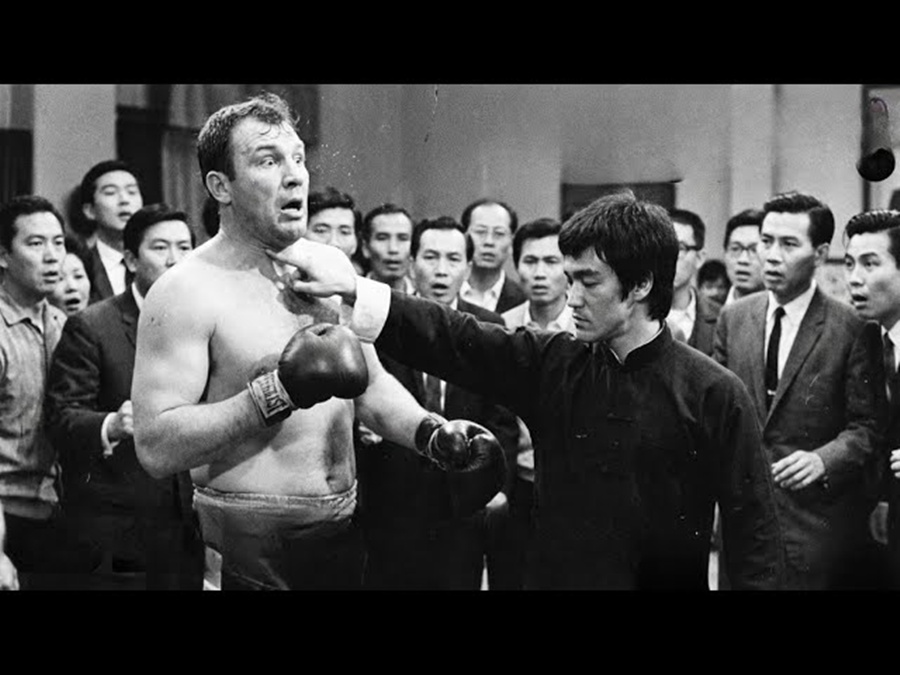
As Victor’s shoulder began to rotate, Bruce’s hand moved. Not his whole body, just his hand. It flickered forward, impossibly fast, covering the distance between them before Victor’s fist had traveled even 6 in from his guard. In the second, Victor felt something he had never felt in a boxing ring. Pressure.
Not impact, not pain, but controlled pressure against his throat right at the soft hollow where the collar bones meet. Bruce’s fingers were not clenched in a fist, but extended, the tips creating a focal point of force that was specific and terrifying in its precision. The third second brought recognition. Those fingers could crush his windpipe with a half inch more pressure.
Victor’s extensive boxing training had prepared him for many scenarios, but not for this, not for combat that operated on principles his sport had specifically ruled out for safety. By the fourth second, Victor’s hands had dropped to his sides. not because he chose to lower them, but because his body’s survival instinct overrode his ego.
Then, as suddenly as it had appeared, Bruce’s hand withdrew. For seconds, Bruce said softly, and there was something in his voice that was not quite sadness, but close to it. Victor’s face had gone pale. His mouth opened, but no words came out initially. I am sorry, Victor said finally, and his voice had lost all its earlier certainty. I am very sorry.
I did not understand. Bruce’s expression softened. You have nothing to apologize for. You came here with honest belief that is not shameful. Being wrong is only shameful if you refuse to learn from it. He gestured toward the heavy bag hanging in the corner. Your boxing is strong. I can see this from your stance, from how you prepared to strike.
But boxing has rules. It is optimized for a specific context. These rules make it safe. Make it a sport. But they also create habits. Bruce continued his voice taking on the patient tone of a teacher. You were telegraphing your intention three movements before your fist would have moved.
Your shoulder rotated first, then your weight shifted, then your hip began to turn. Each of these movements broadcast your plan against another boxer. This is fine, but in a situation without rules, without safety, he let the sentence trail off. Victor ran a hand through his hair. This finger strike you did, he said. This would be illegal in boxing. Unsporting.
Bruce nodded. Yes, but there is no referee on the street. This is why I teach the way I do, not to make people into boxers or kung fu masters. I teach people to survive when there are no rules and then to avoid those situations altogether if possible. Bruce pulled a card from his pocket.
I teach Tuesday and Thursday evening, 7:00. Come if you choose. No charge for the first month. Victor took the card with hands that were no longer quite steady. I will come, he said. I will definitely come, he looked around at the students. I apologize to all of you. I came here with disrespect. I leave with understanding that I know much less than I believed.
Bruce placed a hand on Victor’s shoulder briefly. You honored me by testing your beliefs. This is how truth is found. You have a fighter’s heart. Now you will learn a philosopher<unk>’s mind. 5 years later, Victor Popov had become one of Bruce Lee’s most dedicated students. In an interview conducted in 1982, long after Bruce’s death, Victor was asked what he remembered most about that first encounter.
“I remember his eyes,” Victor said when his fingers were at my throat when he had complete control. His eyes were not angry. They were calm, almost sad, as if he wished the demonstration were not necessary. He could have humiliated me. Instead, he showed me just enough to break my ignorance without breaking my spirit. That is a teacher.
The story spread through the martial arts community, carried by witnesses and then by witnesses of witnesses. Bruce Lee died six years after his encounter with Victor at the age of 32. Victor attended the funeral in Seattle, standing in the rain among hundreds of mourers, holding that business card he had kept in his wallet every day since receiving it.
But that moment in the school on Nathan Road remains alive in a way that transcends both men’s mortality. The lesson from that afternoon transcends martial arts entirely. True confidence does not need to prove itself through domination. True strength lies not in the ability to destroy, but in the choice to teach instead.
Victor came into that school carrying the weight of his accomplishments. He left carrying something lighter but infinitely more valuable. The understanding that what he did not know was more important than what he did know. Bruce understood that the highest form of victory is making an opponent into a student, an enemy into a friend, a confrontation into a collaboration.
The 4 seconds of physical demonstration were merely the vehicle. The real technique was psychological, emotional, philosophical, the art of breaking down barriers without destroying the person behind