MYSTERIOUS Woman Joined Frank Sinatra on Stage — Her Voice Made Him STOP Mid-Song
MYSTERIOUS Woman Joined Frank Sinatra on Stage — Her Voice Made Him STOP Mid-Song

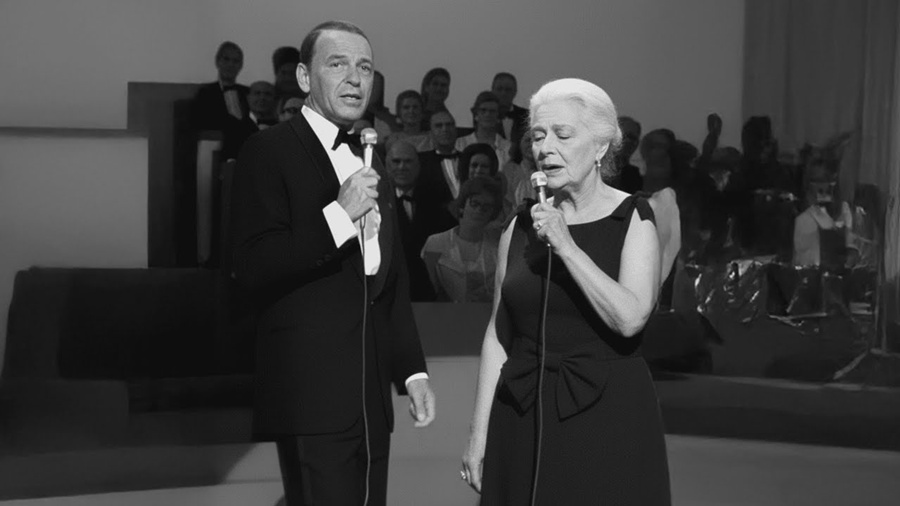
There are three people still alive who know her real name. They’ve refused to say it because the promise they made to Frank Sinatra in 1969 didn’t end when he died. Here’s what we know. October 1969, the Fontinblau Hotel, Miami Beach. Frank Sinatra was halfway through The Way You Look Tonight when an elderly woman walked onto the stage from the audience.
Security moved to stop her. Frank held up his hand. Let her come. She walked to the microphone, started singing with him, not loudly, not trying to take over, just singing. And her voice, Frank stopped midverse, just stopped because she was perfect. Phrasing, timing, emotion, everything. When the song ended, Frank asked, “Who are you?” She smiled.
“You used to know me, Frank, a long time ago.” Then she walked off stage and disappeared into the crowd before anyone could ask questions. No one ever identified her, but people who were there said Frank looked like he’d seen a ghost. Mysteries like this don’t stay buried by accident. They’re protected by people who understand that some truths are more powerful than any legend.
If you want to know what really happened that night and why three people still guard her identity decades later, stay with me. The Font of Blow in October 1969 was one of the most glamorous venues in America. Not Vegas, not New York, Miami Beach, where the elite went to escape winter, to be seen, to watch Frank Sinatra perform in the Laurand room like he owned the place.
The room held 800 people at capacity. That night, it was packed beyond fire code. Celebrities at front tables, wealthy tourists filling the middle section, regular fans pressed against the walls, grateful just to be in the same room as old Blue Eyes. Frank had been performing for about an hour. The set was going exactly as planned.
The band was tight. The pacing was perfect. The audience was his. He was in the middle of the way you look tonight. One of those romantic standards he could make feel like he was singing directly to you. His eyes were half closed, lost in the phrasing. Every word waited with meaning.
That’s when she appeared at the side of the stage. an elderly woman, maybe 70, though it was hard to tell in the low light. She wore a simple navy blue dress, no jewelry, no makeup. Her white hair was pulled back in a neat bun. She wasn’t rushing, wasn’t making a scene, just walking steadily toward the stage with the kind of calm that comes from absolute certainty about what you’re doing.
At first, the security guard near the stage steps didn’t notice her, but as she reached for the railing to climb up, his hand shot out to stop her. “Ma’am, you can’t.” That’s when Frank’s eyes opened. He was still singing, still hitting every note with that perfect control. But his gaze swept across the room and landed on her. For just a second, maybe less.
Something flickered across his face. Recognition, confusion, fear. People in the front row would later disagree about what they saw, but they all agreed that Frank’s expression changed. He held up his right hand while still singing. A clear signal to the security guard. Stop. Let her come.
The guard stepped back, confused, but obedient. You didn’t question Frank Sinatra in his own showroom. The woman climbed the three steps to the stage. Her movements were slow but steady. She walked directly to where a backup microphone stood unused on the left side of the stage, reached for it, turned it on. The audience started whispering.
This had to be part of the show, right? Some surprise Frank had planned, but the band looked as confused as everyone else. The conductor kept conducting, but his eyes kept darting to Frank, trying to understand what was happening. The woman began to sing. And the moment her voice came through the speakers, everyone in that room understood that whoever she was, she wasn’t some random fan.
Her voice was trained, professional, rich and warm with a V that complimented Frank’s perfectly. She wasn’t trying to match him note fornotee. She was harmonizing, adding layers to the melody, turning his solo into a duet that sounded like it had been rehearsed for weeks. But it hadn’t been rehearsed. couldn’t have been because Frank Sinatra, a man famous for his control for never being surprised on stage, stood there with his mouth open, having completely stopped singing.
The orchestra kept playing, the woman kept singing, and Frank just listened. Her voice had that quality that only comes from decades of training and performance. She knew exactly when to breathe, when to hold a note, when to let a phrase fade. She sang the way Frank sang, like she understood that the space between notes was just as important as the notes themselves.
After about eight bars, Frank rejoined her. His voice came back in blending with hers. And for the next two minutes, they sang together. Two voices that fit like they’d been designed as a pair. The audience sat mesmerized, not because it was technically perfect, though it was, but because something about the moment felt real, raw, like watching two people have a conversation in a language only they understood.
When the song ended, there was a beat of silence. Then the room erupted in applause, standing ovation, people on their feet screaming, convinced they just witnessed something historic. But Frank wasn’t acknowledging the applause. He turned to the woman beside him and asked loud enough for the front rows to hear, “Who are you?” She looked at him with eyes that held something between sadness and amusement.
“You used to know me, Frank, a long time ago.” Her voice was quiet but clear. And in that moment, people who were close enough swear they saw Frank’s face go pale. He started to say something. His lips moved, forming words that looked like Elena or maybe Helen. No one could be sure, but before he could finish, she handed the microphone back to its stand, gave him a small knowing smile, and walked off stage, down the three steps, backed through the crowd, which parted for her.
Dozens of people reaching out trying to touch her or ask her name. But she didn’t stop, didn’t look at anyone, just walked steadily toward the back exit and pushed through the doors. The applause continued. The audience wanted more, wanted Frank to explain, to bring her back, to tell them what they’d just seen.
But Frank stood frozen for a moment. Then he picked up his microphone and said, “Ladies and gentlemen, sometimes the past finds you when you least expect it.” His voice was rough, shaken. Let’s take a short break. He walked off stage, not toward the backstage area where performers exit, toward the side door that led to his private dressing room.
The band looked at each other confused. Frank never took breaks midshow, never showed weakness, never let anything throw him off balance. But that night, he did. In his dressing room, Frank sat alone for 15 minutes. His manager knocked twice, was told to go away. When Frank finally emerged, his eyes were red, but his face was composed. He told his manager one thing.
Find out if she’s still in the building. She wasn’t. Hotel staff said they saw her leave through the lobby. A taxi picked her up outside, but when they tried to trace the taxi later, the company had no record of a pickup at that time and location. Security footage from the Fontmbbleau, grainy, limited, only covering main areas, showed her walking through the lobby, but her face was turned away from cameras at every angle, like she knew exactly where they were, like she’d planned her exit to leave as little trace as possible. In
the days after, reporters tried to identify her. They interviewed audience members, ran stories asking who was Sinatra’s mystery singer, but the leads went nowhere. Some people said she looked like a retired opera singer. Others said she resembled a jazz vocalist from the 1940s. No name emerged. No one came forward.
Frank refused to discuss it. Not with reporters, not with his band, not even with his family. When pressed, he’d say it was a case of mistaken identity. Someone who thought she knew him. nothing worth discussing. But people close to him said he was different after that night. Quieter, more reflective, like something had been reopened that he’d spent decades trying to close.
The truth goes back to 1943. 26 years before that Miami Beach stage to a completely different version of Frank Sinatra. In 1943, Frank was at a strange point in his career. He was famous. Bobby Soxers screamed for him. his record sold. But he wasn’t yet the Sinatra of legend. He was still figuring out who he wanted to be.
That year, he performed at a small supper club in Manhattan, a place where musicians went after their official gigs ended to jam and drink and forget about the business side of music. It was there, according to people who were present, and later gave interviews now archived, in the Library of Congress that he met a singer. Her name was Helen.
Not Helen Morrison, though that name appears in a few fragmentaryary documents. Just Helen. She was older than Frank, maybe 15 years older and in her late 30s when they met. And her voice was extraordinary, classically trained, oporadic range, but drawn to jazz and standards, able to move between genres with an ease that made other singers jealous.
Someone at the club suggested they sing together. Frank, never one to back down from a musical challenge, agreed. They chose The Way You Look Tonight. And the moment their voices met, everyone in that smoke-filled room knew they were hearing something special. Not just two good singers, two voices that fit together like they’d been designed as a pair.
They spent the next six months in each other’s orbit. Not romantically according to those who knew them, but something deeper. A connection that was artistic and emotional. A mentorship that felt like friendship. A friendship that felt like something neither of them could name. Helen taught Frank things about phrasing, about breath control, about using silence as an instrument, things he’d carry with him for the rest of his career.
They talked about music, about what it costs to succeed, about compromise and integrity, and whether you could have both. And then Helen disappeared. No explanation. One week she was there. The next she wasn’t. The club owner said she’d left New York. Someone else heard she’d gone to Europe. Another rumor suggested she’d gotten married and retired from performing. Frank tried to find her.
Asked everyone who might know. But in 1943, people could vanish if they wanted to. No internet, no social media, no easy way to track someone who didn’t want to be found. Eventually, he stopped looking, moved on with his life, his career, his marriages and divorces and comebacks and failures.
But people who knew him said he always asked about her, always wondered what happened, always carried that question. 26 years later, she walked onto his stage in Miami Beach. 26 years older, white-haired instead of dark, lines on her face that hadn’t been there before, but that same voice, that same presence.
And in those two minutes, she gave him something he’d been missing. Closure, maybe, or accountability, or just the reminder that some connections don’t fade no matter how much time passes or how famous you become. After that night, three people knew the full story. Frank himself, his longtime road manager, who’d been with him since the 1940s and knew about Helen from the beginning, and Frank’s personal attorney, a man who’d handled Frank’s most private affairs for decades.
Before Frank died in 1998, he made these two men promise something. Never reveal her real name. Never identify her publicly. Let the mystery remain. Why? Some say Helen had built a new life, married, had children who didn’t know about her performing past, and Frank was protecting her privacy. Others suggest something darker, that Helen’s disappearance in 1943 wasn’t voluntary, that she’d been running from something, and Frank’s silence was keeping her safe even decades later.
But there’s another possibility, simpler, maybe more true to who Frank was. He wanted one thing in his life that remained private. One connection that wasn’t dissected by the media, wasn’t turned into gossip, wasn’t commodified for public consumption. In a life lived almost entirely in spotlights, those two minutes in Miami Beach were something that belonged only to him and to her.
The two men who knew her name kept their promise. The road manager died in 2004. The attorney is now in his 90s and has refused every interview request, every book deal, every attempt to get him to reveal what he knows. He said only one thing publicly. Some secrets are kept because they protect people. Frank knew which kind this was.
There’s a third person who knows, Helen herself. If she’s still alive, she’d be nearly 110 now. Unlikely, but not impossible. More likely, she passed away years ago, taking her side of the story with her. In 2015, a music historian claimed to have found her, a woman who’ lived in Sarasota, Florida, who matched the age and had the background.
But the woman had died in 2008. Her family confirmed she’d been a singer in the 1940s, but said she never mentioned Frank Sinatra. The Fontenna Blow still stands. The Laurand room where Frank performed was renovated in the 1990s, but the bones of it remain. If you stand on that stage now, you can almost feel the ghosts of performances past.
In online forums, you can still find firsthand accounts from people who were there that October night in 1969. They all remember the woman in the Navy dress. They all remember her voice blending perfectly with Frank’s. And they all remember Frank’s face when she said, “You used to know me.” Frank Sinatra recorded hundreds of duets in his career, but he never recorded with Helen.
Never mentioned her name in any interview. Never acknowledged publicly that she existed. Those two minutes in Miami Beach were all that remained. A performance that existed only in memory because no one was recording that night. The mystery endures because Frank wanted it to because three people made a promise because Helen, wherever she is, chose to remain unknown.
And maybe that’s exactly how it should be. In a world where every secret eventually gets exposed, where where privacy is nearly impossible, there’s something almost sacred about a mystery that remains unsolved. What we’re left with is this. On an October night in Miami Beach in 1969, Frank Sinatra shared his stage with a woman from his past.
They sang one song together, 2 minutes, and it shook him in a way that success never could. Because sometimes the most powerful moments in life aren’t the ones you plan or control. They’re the ones that just happen. Unexpected, unscripted, unexplainable to anyone who wasn’t there. The audience that night thought they’d seen a performance.
But they’d witnessed something rarer. A moment of truth between two people who’d found each other once, lost each other, and found each other again just long enough to say everything that had never been said. And then she walked away. And Frank let her because some connections aren’t meant to be captured or preserved or explained.
They’re meant to exist in memory, protected by silence, guarded by people who understand that not every story needs an ending that makes sense to everyone else. Three people know her name. They’re keeping their promise. And the woman in the navy dress, wherever she is, is keeping hers. The mystery remains.
Maybe that’s the most honest ending possible.