Muhammad Ali Stepped Forward — Bruce Lee Never Stepped Back
Muhammad Ali Stepped Forward — Bruce Lee Never Stepped Back
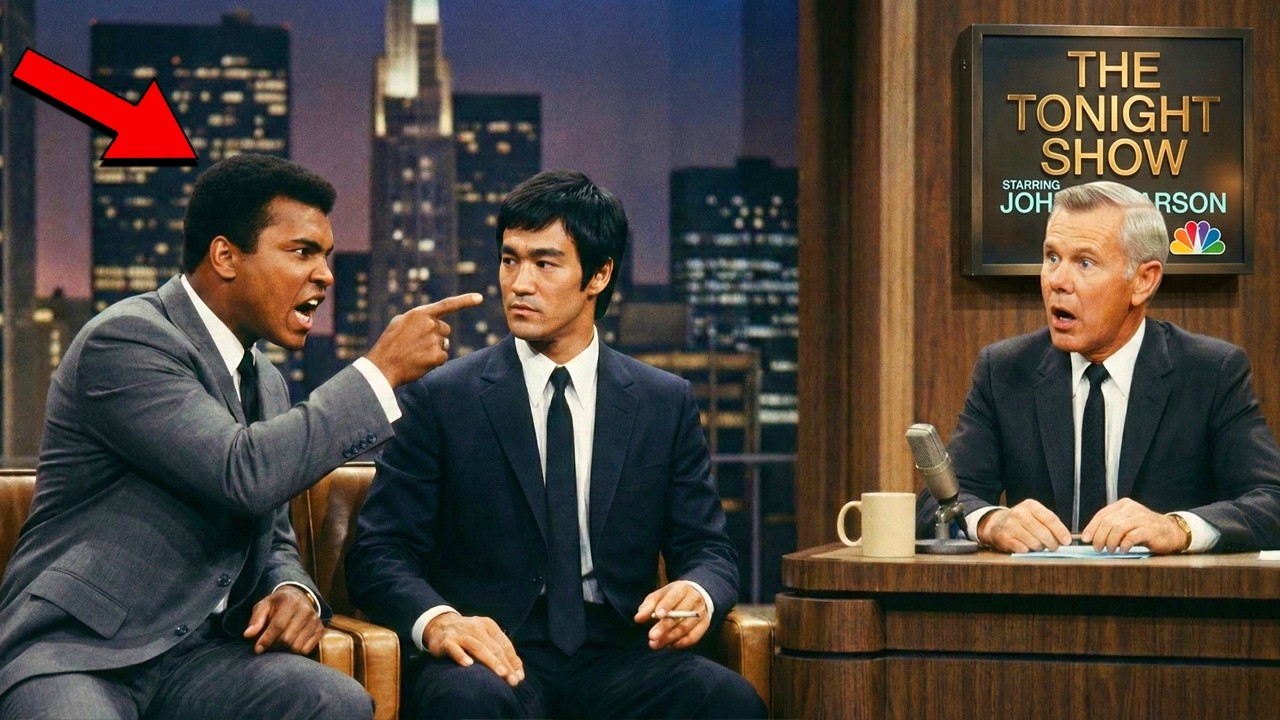
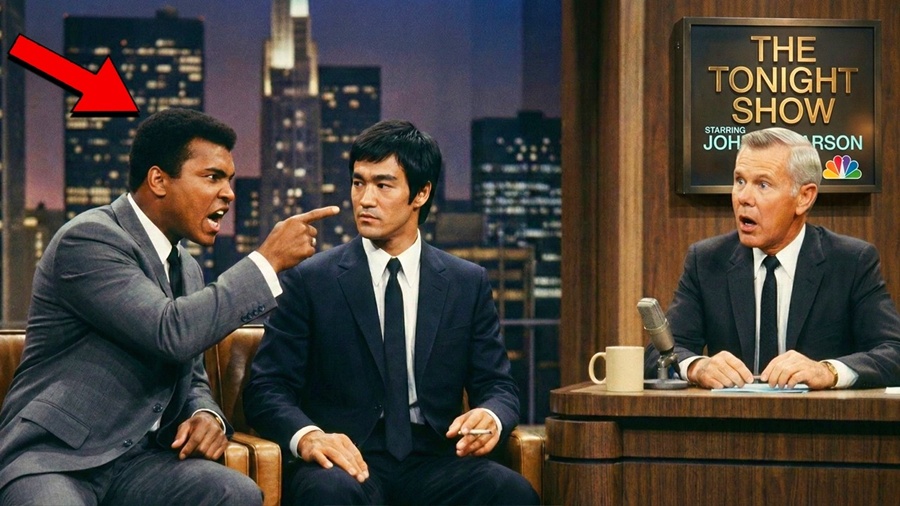
On the Tonight Show, the stage is set for a standard celebrity interview. Johnny Carson runs through his monologue, jokes about Nixon, Vietnam, Hollywood. The audience responds the way it always does. Bruce Lee has already been introduced. He’s in the guest chair answering the expected questions about the Green Hornet, about breaking boards, about martial arts.
The answers are polite and professional. Nothing unusual. Carson wraps the segment and teases what’s coming. And later, the heavyweight champion of the world, Muhammad Ali. During the commercial break, stage hands adjust cameras. Carson reviews his note cards. Bruce stays in his chair and waits. He’s not anxious about the cameras or the audience. He’s thinking about Ali.
They’ve never met, but Bruce knows Alli’s reputation, commanding, outspoken, comfortable, being the loudest presence in any room. He also knows Ally has made his views on martial arts clear in interviews, called it movie fighting, and said, “Boxers are real fighters, martial artists are performers.
” Bruce has read those quotes. They bother him, not as a personal slight, but as a matter of principle. Martial arts is legitimate combat training. It deserves to be treated as such. The break ends. Carson turns to camera. My next guest needs absolutely no introduction. The heavyweight champion of the world, Muhammad Ali. The curtain opens.
Ali walks through and the audience is immediately on its feet. He does his shuffle. Throws phantom punches, plays to the crowd. He shakes Carson’s hand and takes the seat beside Bruce, maybe 3 ft between them. For the next five minutes, it’s the standard Ali performance. Training stories, fight talk, the usual bravado.
The audience is entertained. Then Carson steers the conversation. Muhammad, we have Bruce Lee here, martial arts expert. What’s your take on kung fu? Ally looks at Bruce for the first time. Takes him in. The smaller frame, the stillness, the quiet. Kung fu, Ally says, that’s movie stuff. Real fighting happens in the ring. Real punches, real power.
The audience quiets. The tone has shifted. Bruce’s jaw tightens slightly. Martial arts is very real. It’s been tested for thousands of years. Tested against who? Other kung fu guys? That’s practice, not testing. Ellie turns to the audience. You want real fighting? Watch boxing. Watch me knock someone out.
Carson tries to moderate. I’m sure both have their merits. There’s no comparison, Ellie says. Boxing is the sweet science. What Bruce does is choreography. Looks good for cameras. wouldn’t hold up against a real fighter. Bruce keeps his voice level. Boxing’s effective. I’ve never said otherwise, but it’s limited to fists.
No kicks, no grappling, no elbows or knees. Real fighting has no rules. Rules are what separates sport from street brawling. Any thug can throw a wild kick. Boxing takes skill, but takes discipline. I agree. But martial arts has all of that, plus more tools. Then Ally stands up. He walks to the center of the stage, an open area away from the chairs. The audience stirs.
Come here, Bruce. Let’s show these people something. Bruce doesn’t move right away. This is live television. 20 million people watching. No contact. Ally says, “Just movement. Let’s show them the difference.” Right, Bruce? Bruce stands and walks to where Ally is waiting. The physical contrast is immediate. Ally is 6’3. Bruce is 5’7.
Ally has 80 lb on him. The visual is sharp. Here’s what I want to know. Ally tells the audience. Can kung fu handle boxing speed? He looks at Bruce. I’m going to throw some jabs. Light, not trying to land. You do whatever you do. Block, slip, your choice. Show the people it works. Bruce nods. Okay. Ally settles into his stance.
Left foot forward, hands up. The stance that has won him every title. I even stationary. He looks dangerous. He throws a jab. Fast pulled. Not trying to land, but fast. Bruce’s head moves. Minimal, efficient. The punch passes. Another jab. Same result. Then a third. Then a combination. Jab. Jab. Cross. All of them miss. The audience murmurs.
This small man can move. Ally pauses. He’s not frustrated, but he’s paying attention. Not bad. That was maybe 50%, let’s try 75. Your choice. Ally picks up the pace. More complex combinations now. Jab, cross, hook, double jab, uppercut. The kind of sequences that have made him champion.
still pulled but moving much faster. Bruce handles all of it. The head movement remains minimal and precise, just enough to make each punch miss by the smallest possible margin. Ally stops. The showmanship is gone now. He’s thinking, “All right, you can slip punches, but can you do anything offensive or just defense?” Both. Then show me. Try to hit me.
Bruce steps forward. His hands come up. Open palms, fingers relaxed. He throws a straight punch. Not slow, not fast, just moving. Ally leans back. Easy. The punch misses by six inches. Too slow. Bruce tries again. Different angle. Alli’s head moves again. Effortless practiced. A lifetime of this.
The audience starts to laugh. Not unkindly. It’s Ali’s showmanship. The way he’s making the evasion look simple. Bruce throws a third attempt. This time he doesn’t pull back after missing. He steps inside Ali’s reach, but his hand comes up, open palm, and touches Ali’s chest. light contact. “Got you,” Bruce says quietly. Ally looks down at the hand.
“That’s not a hit. That’s a tap.” “In a real fight, that’s a strike to the solar plexus. It stops your breathing.” “Is that right?” Allie’s voice shifts, gets harder. “That’s a big claim. It’s not a claim. It’s what would happen.” The energy on stage changes. Carson can feel it. Gentlemen, this has been very entertaining, but maybe we should.
No, Ellie says, he looks at Bruce directly. You’re saying that little tap would stop me? The heavyweight champion if I struck instead of tapped? Yes. Then do it. The studio goes silent. I don’t think that’s a good idea, Bruce says. Why not? Scared it won’t work. Scared everyone sees kung fu is fake. Scared I’ll hurt you.
You have a fight coming up. Ally laughs. Hurt me? You weigh 140 lbs. You couldn’t hurt me if you tried. Come on, free shot. Show these people what that training is worth. Actually, hit me. He points to his chest. Bruce looks at Carson. Carson looks back, unable to do anything. This is live. “Okay,” Bruce says.
But I’m telling you, this is a bad idea. I’m a big boy. Bruce repositions. His hand is still resting on Ali’s chest. Same spot over the heart. He settles his weight. His back foot presses slightly into the floor. You sure? Do it. There’s a sound sharp like a clap. The studio mics catch it clearly. Ali’s eyes go wide. His body goes rigid for a fraction of a second.
Then he steps backward. One step, two, three. His hand goes to his chest, pressing, testing. His face shows something between confusion and shock. The audience gasps. Muhammad Ali stepped back. Ali stands there, hand still on his chest. He’s trying to process what his body just experienced. That wasn’t an impact he recognized.
It didn’t feel like a punch. It felt like something else entirely. Carson is frozen behind his desk. The Ed McMahon stares. The band has stopped. The entire stage has gone still. Ali takes a breath. Then another. What? His voice is rough. What was that? Fing explosive power. I used about 30%, I didn’t want to actually hurt you. 30% did that? Yes.
What does 100% do? Bruce is quiet for a moment. Broken ribs, internal damage, possibly worse. Ally stares at him. He’s seeing something different now. This isn’t a movie actor. This is someone who understands things he doesn’t. Carson finds his voice. Let’s take a commercial break. During the break, nobody really moves.
Ally remains center stage, hand on his chest, working through what happened. Bruce returns to his chair. His hands are shaking slightly. Adrenaline. That exchange could have gone wrong in several directions. Ally walks back to his chair slowly. He sits down like he’s checking whether it will hurt. It doesn’t. Not physically.
They come back live. Carson doesn’t know where to go. The planned questions feel beside the point. Muhammad, you okay? Yeah, I’m okay. The usual volume isn’t there. That was quite a demonstration. That wasn’t a demonstration. That was education. Ally looks at Bruce. I owe you an apology. What I said about martial arts being fake, about kung fu being movie fighting, I was wrong.
I was disrespectful. I’m sorry. The audience applauds. Bruce nods. May apology accepted. Can I ask you something? Sure. Can you teach that? What you just did? The technique? Yes. The understanding behind it? That takes years. How many years? I’ve been training since I was 7. 25 years. And I’m still learning. 25 years. Ally pauses.
You’ve been boxing since you were 12, right? 12. 20 years. Same dedication, same discipline, different methods. Ally sits with that for a moment. You You know what? I judge something I didn’t understand. Made assumptions based on ignorance. That’s on me. Carson leans in. So, you’re saying martial arts is legitimate? I’m saying Bruce Lee is legitimate.
Can’t speak to all martial arts. But what he just did, that was real. That was skill. I’ve been hit by the hardest punchers in boxing. Sunny Lon, Joe Frasier, George Foreman. Nothing felt like that. Those hits push you. This hit. Ally searches for the right words. It felt like getting hit from the inside, like the force went through my chest instead of against it.
Bruce explains, “Boxing power is external muscle generated force delivered to the surface. What I used is internal power. It bypasses the surface and delivers force directly to vulnerable structures underneath. Can boxers learn that?” Some can, but it requires changing how you think about power, how you generate it. Most boxers rely on muscle and technique.
This requires relaxation and whole body coordination. Ellie nods. When you hit me, you weren’t tense. I felt that you were relaxed, but the power was. He shakes his head. How’s that possible? Tension restricts. Relaxation allows. When your muscles are tense, they work against each other. When they’re relaxed but coordinated, they work together much more efficient. I want to learn this.
Ally says it plainly to Bruce to the audience. She You just showed me there’s a level of fighting I don’t understand. I don’t like not understanding things. Can I come to your school? You serious? Dead serious. I have a school in Los Angeles, Chinatown. Come by anytime. I’ll be there next week. Carson is smiling.
This is better than anything he planned. Well, this took an unexpected turn. That’s what happens when you check your ego. Ay says, “I came out here thinking I knew everything, thinking boxing was supreme. Bruce showed me I was wrong. I could have gotten defensive. I could have made excuses, but why? The man proved his point. Only an idiot doesn’t learn from that.
The rest of the show is a different kind of conversation. The tension has cleared. Ally asks about training, about philosophy, about how boxing and martial arts differ at their foundations. Bruce answers without posturing, not establishing superiority, just sharing what he knows. By the end, both men are laughing, talking about discipline, about the pursuit of improvement, about what it actually takes to become good at something.
They’re finding common ground because the common ground was always there. After the show, backstage, Ally approaches Bruce. I meant what I said. I’ll actually come by. I’ll be there. That thing you did, if you’d used full power, would it have killed me? Bruce answers directly. Maybe. Depends on placement and force. The heart is vulnerable. Hit it wrong and it stops.
I pulled it significantly. Used just enough to make the point. Ally touches his chest again, still tender. I felt that. Felt you holding back. Thank you for that. Thank you for being willing to learn. Most people in your position would have gotten angry, made excuses. You didn’t. You acknowledged it and wanted to understand. That’s not common.
They shake hands. The handshake holds for a moment. Both men aware that something real just happened between them. Uh Ally visits Bruce’s school the following week. Tuesday evening, he shows up in gym clothes, ready to train. Bruce’s students can’t quite believe what they’re seeing. Ally struggles. His body wants to box, wants to drive from the arm to rely on muscle to force power the way he always has.
Bruce keeps redirecting him. Relaxation, whole body coordination, not strength. This is hard, Ally admits. Harder than boxing training because you’re unlearning 20 years of muscle memory. Your body knows how to box. Knows it at a deep level. Teaching it something different means breaking patterns that are already built in.
How long before I can do what you did on the show? Years. Maybe never. Not because you can’t learn it, but because your body is already specialized for boxing. Changing that at the level you’re operating at is difficult. Possibly not achievable. Alli accepts this without complaint. So, I’ll never be as good at martial arts as I am at boxing. Probably not.
But you can understand the principles, apply some of them, make your boxing better by incorporating what translates. They train together occasionally over the following months whenever Ally is in Los Angeles and schedules allow. Ally doesn’t become a martial artist, but his footwork improves, his reading of distance improves, his ability to anticipate opponents improves, and his public position on martial arts changes entirely.
He stops making dismissive comments. When asked about Bruce Lee, his answer is consistent. Bruce Lee is the real deal. Not just skilled, masterful. He hit me once and I stepped back. Me, I don’t step back ever, but I stepped back from him. That tells you everything you need to know. The footage from that night on the Tonight Show is replayed for years, it becomes standard viewing in martial arts schools and boxing gyms alike.
The moment two masters met on live television. And what came out of it? Ally came forward. Bruce never stepped back. Bruce didn’t need to retreat. He stood his ground, absorbed the challenge, and responded with control. And Ali, who had built a career on never yielding, stepped back, not from intimidation, from something he encountered that he hadn’t encountered before.
The footage documents education more than confrontation. The moment when a confident, a settled assumption meets a contradicting reality and has to adjust. In interviews years later after Bruce had died, reporters still asked Ally about that night. I’ll never forget it. Ali sail. I came out thinking I was going to show up this kung fu movie guy.
Prove boxing was in a different category. Instead, he showed me clearly with control and precision made me step back. Made me rethink things I considered settled. Do you regret it? Regret getting educated. Learning something new. The number one. I’m grateful. Bruce could have embarrassed me. Could have used full power.
He didn’t. He used just enough to teach. That’s mastery, not the power, the control. What did you take away from it? That fighting is bigger than I thought. That skill takes many forms. That someone half your size can be twice as dangerous if they understand what you don’t. That respect should follow ability, not assumptions.
That being the best at one thing doesn’t mean you’re the best at everything. The story stays in circulation, gets told and retold, analyzed, and questioned. Was it real? Was any of it staged? Did Bruce actually make Ally step back? The answer is yes. All of it happened on live television in front of millions of viewers.
Ally stepped forward, certain imposing, operating on the assumption that his size and strength and title made the outcome predictable. Bruce never stepped back or he held his position, met the challenge, applied his technique, and Ally stepped back three steps, hand on his chest, eyes wide. That moment of transformation is what the footage preserves.
Not the technique, the response to it. The willingness of a man at the height of his reputation to acknowledge that he’d encountered something beyond his understanding and to say so plainly. Both men showed a kind of mastery that night. Ali showed it in how he responded to being wrong without deflection, be without excuses, with the directness of someone who respects evidence.
Bruce showed it in his restraint, in measuring the force precisely, in choosing to teach rather than to dominate. What they demonstrated together was larger than boxing or martial arts. It was the capacity to change an opinion when the evidence demands it, and to pursue understanding over the defense of prior assumptions. Ali stepped forward.
Bruce never stepped back. And in that exchange, on that stage, when something was settled, not about which discipline is superior, but about what mastery actually is. It’s understanding, not just strength, control, not just force, and the willingness to learn, even when learning means admitting you were wrong. Two figures met that night, and both left with more than they arrived with.
Ally gained understanding. Bruce gained recognition and the record of what happened between them became one of the more consequential moments in the history of either sport. Not for the technique displayed, but for the character it revealed.