Johnny Cash Walked Into Bumpy Johnson’s War With Only a Guitar — No One Expected What Came Next
Johnny Cash Walked Into Bumpy Johnson’s War With Only a Guitar — No One Expected What Came Next
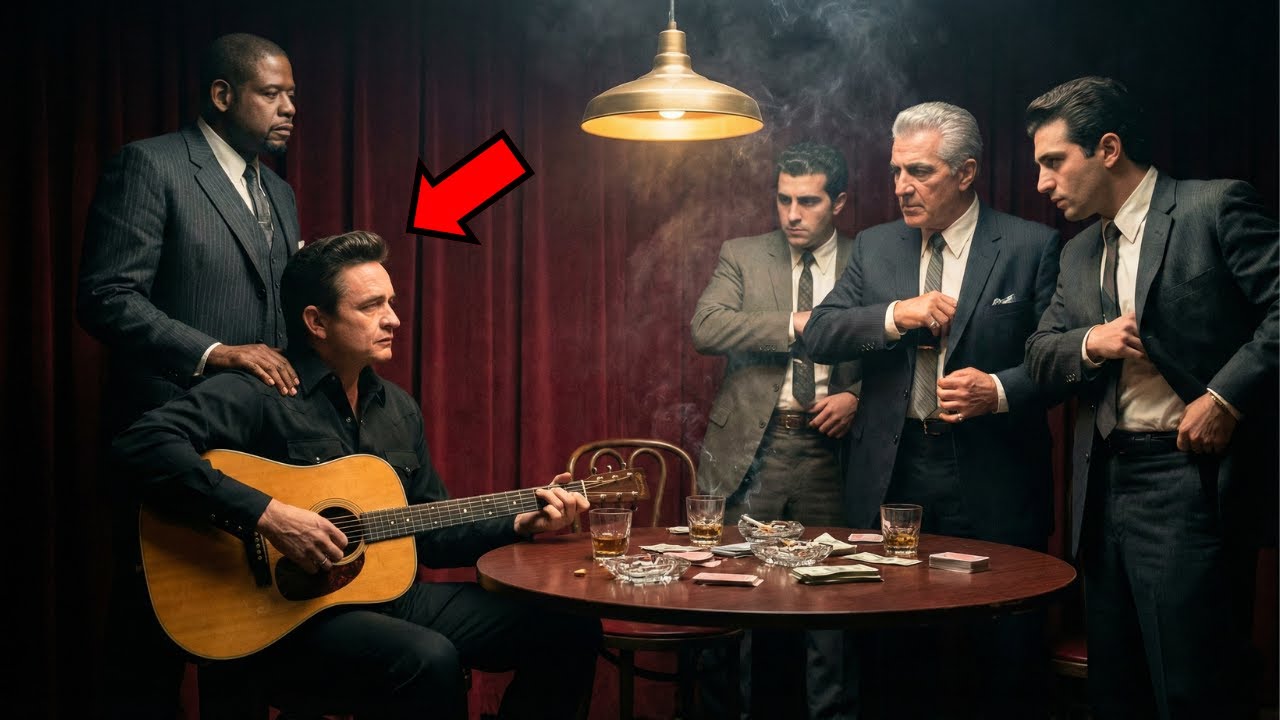
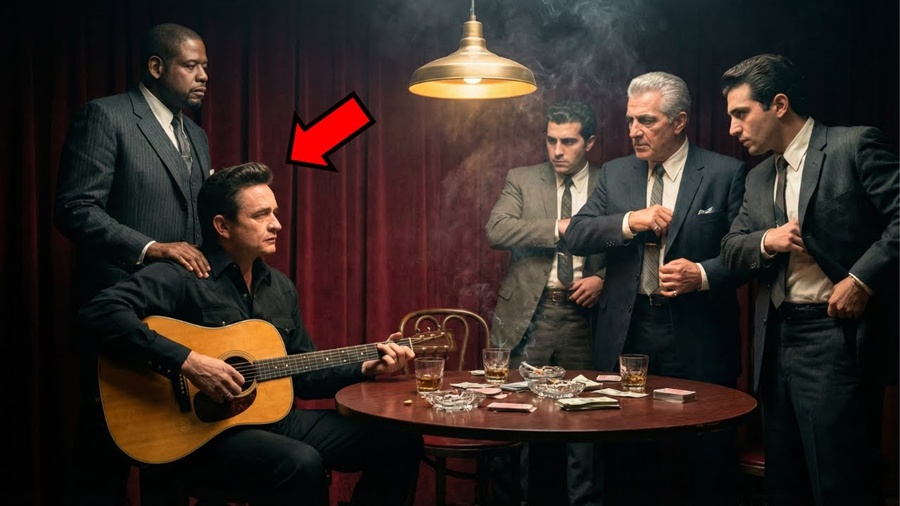
December 14th, 1967. The backroom of Smalls Paradise, Harlem. Johnny Cash was sitting at a round table with a guitar in his lap and 12 guns pointed at his chest. Six belonged to Bumpy Johnson’s men. Six belonged to the Genovese family. And somewhere between the click of hammers being pulled back and the last satisfying breath before chaos, Johnny Cash realized he had exactly 90 seconds to do something he’d never done before. Sing for his life.
But here’s what nobody in that room knew. Johnny Cash wasn’t supposed to be there at all. He wasn’t a negotiator. He wasn’t a diplomat. He was just a country singer from Arkansas who’d made one phone call to the wrong person at the wrong time. And that phone call had led him into the most dangerous room in New York City.
What happened in the next four minutes would become the most closely guarded secret in Harlem’s history. A story that Bumpy Johnson took to his grave 7 months later. A story that Johnny Cash never told anyone, not even June. To understand how Johnny Cash ended up in that room, you have to go back 3 days earlier. December 11th, 1967.
Johnny was in New York for a television appearance, staying at the Warick Hotel. He’d been clean for almost 8 months, the longest stretch since his addiction began. June was back in Nashville, and Johnny was alone, fighting the familiar demons that always seemed louder when she wasn’t around.
At 2:30 in the morning, his phone rang. The voice belonged to Marcus Webb, a blues guitarist Johnny had met in Memphis back in 1958. Marcus had taught him things about rhythm and pain that no white musician could have shown him. They’d lost touch years ago, but Johnny had never forgotten him. Marcus’ voice was shaking.
His nephew, Jerome, had gotten mixed up with Italian lone sharks. The kid owed $12,000, and the Italians were going to kill him by Friday. But Jerome also worked for Bumpy Johnson, just a runner who delivered numbers slips, but he was under Bumpy’s protection. When the Italians grabbed Jerome and beat him half to death as a warning, they didn’t just threaten one kid.
They insulted Bumpy Johnson. And in Harlem, insulting Bumpy Johnson was the same as declaring war. Marcus explained that Bumpy had already called in soldiers from Baltimore and Philadelphia. The Genevese family was doing the same. By the weekend, Harlem would become a war zone. Hundreds would die, most of them innocent bystanders.
Marcus’s nephew would be executed first as a message before the shooting even started. Johnny asked what a country singer could possibly do about a gang war in Harlem. Marcus was quiet for a long moment. Then he said something that would change everything. He said that Bumpy Johnson was a fan, a serious fan. Marcus had been in Bumpy’s office once when Fulsome Prison Blues came on the radio.
And Bumpy had stopped everything just to listen. When the song ended, Bumpy had said that Johnny Cash was the only white man in America who understood what it meant to be trapped. Marcus had a crazy idea, but it was the only idea anyone had. The next morning, Johnny Cash did something his manager would have called suicide. He took a taxi to Harlem alone.
No security, nothing but his guitar case and an address. The driver dropped him on 135th Street in front of a barber shop that didn’t look like anything special. But Johnny noticed the men on the corners, noticed how they watched him, noticed how word traveled down the block before he’d reached the door.
He walked in and the conversation stopped. Eight black men stared at him like he’d landed from another planet. A white man in an expensive coat carrying a guitar walking into Bumpy Johnson’s territory. It was either the bravest thing they’d ever seen or the stupidest. An older gentleman in the corner getting his hair trimmed looked at Johnny with an unreadable expression.
He told the barber to finish up. Then he stood, extended his hand, and said his name was Ellsworth Johnson, but most folks called him Bumpy. He said he’d been wondering when Johnny Cash would come to Harlem. They talked for three hours, and what struck Johnny most was how different Bumpy was from what he’d expected.
He’d imagined a gangster, someone rough and violent. Instead, he found a man who quoted Shakespeare, discussed philosophy, had opinions about poetry that would have impressed any professor. Bumpy was 61 with gray at his temples and eyes that had seen more than any man should see. He spoke softly, never raising his voice.
But there was something beneath that softness Johnny recognized immediately. The weight of having done things you couldn’t undo. Bumpy explained the situation clearly. He didn’t want a war. War was bad for business, bad for the community, bad for everyone. But he couldn’t let the Italians disrespect him. In his world, respect was currency.
If he let them beat one of his people and walked away, his empire would crumble within months. The Italians knew this. They wanted a war because they wanted Harlem. Johnny asked what it would take to stop it. Bumpy leaned back and considered the question. The problem wasn’t the money. 12,000 was nothing. The problem was face.
Both sides had made public threats. Both sides had drawn lines for either to back down would be seen as surrender. What they needed was a third party, someone both sides respected, someone who could create a situation where backing down didn’t look like weakness. Johnny asked why he could be that person. Bumpy smiled for the first time.
He said Johnny Cash had sung for prisoners, for soldiers, for the forgotten and the damned. He’d walked into places where no white man dared and come out with their respect. He said that Carmine Dilva, the Genevese captain who controlled East Harlem, was also a fan, had every Johnny Cash record ever made. If anyone could get both sides in a room, it was the man in black.
But Bumpy warned him, “If Johnny stepped into this, there would be no turning back. These weren’t businessmen. These were killers. If the negotiation failed, Johnny would die with the rest of them. No one would be able to protect him. Johnny thought about June, about the life he was rebuilding, about all the reasons to walk away.
Then he thought about Marcus’s nephew, a 19-year-old who’d made a stupid mistake and was about to pay with his life. He thought about all the innocent people who would die if this war happened. He picked up his guitar case and asked when they could set up the meeting. The next two days were a blur of secret calls and clandestine meetings.
Johnny became a messenger between Bumpy and Carmine Dilva, each man testing the other. Neutral territory was agreed upon. Smalls Paradise, the legendary nightclub, closed to the public that Saturday night. Each side would bring six men. Weapons would be checked at the door, though Johnny suspected this rule would be honored more in theory than practice.
On the morning of December 14th, Johnny woke with a feeling he hadn’t experienced since his Air Force days. Real fear, the kind that settles in your stomach and doesn’t leave. He called June. He didn’t tell her where he was going. He just told her he loved her, that she was the best thing that had ever happened to him.
that no matter what happened, she should know that. June sensed something was wrong, her voice turning worried. Johnny told her not to worry. He said he had some business to take care of and he’d call her tomorrow. He hoped that was true. That evening, at exactly 1000 p.m., Johnny Cash walked into Smalls Paradise. The club was empty except for the people who mattered.
Bumpy Johnson sat at a round table flanked by six of his men. Across from him, Carmine Dilva occupied an identical position, his soldiers standing like statues behind him. The tension was so thick, Johnny could taste it, metallic and sharp, like blood before it spilled. Johnny took his seat at the head of the table, guitar case beside him. Bumpy nodded.
Carmine did the same. For a moment, nobody spoke, and then Carmine opened his mouth, and everything went to hell. Carmine Dilva leaned forward, his manicured fingers drumming on the table. His first words weren’t directed at Bumpy. They were directed at Johnny. He said he was disappointed. He said he’d expected a man who sang about shooting people in Reno just to watch them die would understand how business worked.
He said Johnny Cash had no place at this table. that this was a conversation between men who actually mattered, not some hillbilly entertainer playing dress up in his little black outfit. The room went cold. Bumpy’s men shifted. Johnny felt something change in the air, something dangerous. But before anyone could respond, Carmine turned to Bumpy and delivered the real insult.
He called him an old man. He said Bumpy’s time was over, that Harlem belonged to whoever had the strength to take it, and that strength wasn’t sitting on Bumpy’s side of the table anymore. He said the kid Jerome was already dead. They’d killed him that afternoon, dumped his body in the East River.
This meeting was just a courtesy, a chance for Bumpy to surrender his territory before things got worse. The silence that followed lasted exactly 4 seconds. Then Bumpy laughed. It was a quiet laugh, almost gentle, the kind of laugh a grandfather might make at a child’s joke. But his eyes weren’t laughing. His eyes were calculating distances, measuring angles, deciding who would die first.
He reached into his jacket and suddenly everyone was moving. Bumpy’s men drew their weapons. Carmine’s men did the same. 12 guns pointed across that table, hammers clicking back, fingers finding triggers. Johnny was caught in the middle, frozen in his chair, watching death arrange itself around him, like a symphony tuning up before the final movement.
Carmine was smiling. This was what he wanted. He’d come here to start a war, not prevent one. The lie about Jerome was designed to provoke exactly this reaction. Johnny understood it now. Understood it too late. He’d been played. They’d all been played. Bumpy’s voice cut through the tension like a razor. He told everyone to wait.
Just wait. He looked at Johnny and in that look was something Johnny hadn’t expected. It wasn’t fear. It wasn’t anger. It was curiosity. Bumpy asked Johnny if he’d brought his guitar. Johnny nodded, not trusting his voice. Bumpy told him to play something right now. Johnny thought he’d misheard. 12 guns were pointed at people’s heads, and Bumpy wanted music, but Bumpy’s expression made it clear this wasn’t a request.
Johnny reached down, opened his guitar case, and pulled out his martin. His hands were shaking. He could barely feel his fingers. Carmine laughed and asked if they were going to have a concert while Rome burned. He told his men to finish this, but something strange happened. None of Carmine’s men moved. They were looking at Johnny at the guitar.
At the man in black sitting in the middle of a war zone like he belonged there. One of them, a young soldier named Tony, who couldn’t have been older than 25, lowered his gun slightly. He said he wanted to hear a song. His voice was barely above a whisper. But in that silent room, everyone heard it. Johnny looked at Tony, then at Carmine, then at Bumpy.
He understood something in that moment. These men, all of them, were tired. Tired of the violence, tired of the threats, tired of living one bad decision away from a bullet. They’d built walls around themselves, walls of reputation and fear. And now those walls were crushing them. They couldn’t back down because backing down meant death, but they didn’t want to die either.
Not really, not tonight. Johnny’s fingers found the strings. He didn’t think about what to play. He just played. The first notes of peace in the valley rose into the smoky air of Smalls Paradise. It was a gospel song, an old song, something his mother used to sing when he was a boy in Arkansas.
His voice came out rough at first, cracking with fear. But then it found its footing. The words spoke of a place where there was no sadness, no trouble, no crying. A place where the lion would lay down with the lamb. It was a song about hope, about the possibility that enemies could become brothers, about the belief that somewhere somehow peace was possible.
The room changed. Johnny could feel it changing. could feel the tension draining out like water from a cracked vessel. Guns lowered one by one. Not all the way, but enough. Men who had been ready to kill each other 30 seconds ago, were now listening to a country singer from Arkansas tell them about heaven. Tony, the young Italian soldier, had tears in his eyes.
He was trying to hide it, but Johnny saw. One of Bumpy’s men, a giant named Roosevelt, who had killed more people than anyone in that room could count, was nodding along to the melody. His lips were moving silently, following the words. When the song ended, nobody spoke. The silence was different now. It wasn’t the silence before violence.
It was the silence after something sacred. Then Tony’s voice broke the stillness. The young Italian soldier, the one who had lowered his gun first, was shaking. He said Jerome was alive. He said Carmine had been lying. The body in the East River was someone else. Tony said he was tired. Tired of the killing. Tired of the lies.
Tired of watching his friends die for money that none of them would ever get to spend. Carmine turned on Tony with murder in his eyes. But Johnny spoke before Carmine could respond. Johnny’s voice was steady for the first time that night. He said, “Tony just gave everyone in this room a gift, the gift of truth.” He said, “Wars don’t just kill enemies.
Wars kill sons and brothers and fathers. Wars kill the young soldiers standing behind both of them right now.” He looked at Carmine and asked if he really wanted to send Tony home in a box for telling the truth. Carmine’s face twisted with rage, but it was too late. The other Italian soldiers were nodding. They were tired, too. They hadn’t signed up for a war.
They’d signed up for a job. And this job was becoming something none of them wanted. Bumpy watched all of this with that same unreadable expression. Then he did something that surprised everyone, including Johnny. He stood up, walked around the table, and extended his hand to Carmine.
He said they could end this right now. Jerome’s debt would be forgiven. The insult would be forgotten. Both sides would walk away. And tomorrow the sun would rise on a Harlem that wasn’t burning. Carmine stared at that hand like it was a snake. His pride was screaming at him to refuse, to punish Tony for his betrayal, to burn everything down rather than show weakness.
But his soldiers were watching and they weren’t going to follow him into a war he’d started with a lie. Carmine shook Bumpy’s hand. The grip was brief, almost violent, but it happened. And just like that, a war that would have killed hundreds of people ended in the back room of a Harlem nightclub at 12:15 in the morning.
Johnny Cash sat at that table with his guitar in his lap, watching two men who hated each other choose peace over pride. He thought about all the wars that could have been prevented if someone had just played the right song at the right moment. He thought about Marcus’s nephew, Jerome, who would live to see another day. He thought about June, waiting for his call back in Nashville.
Bumpy walked Johnny to the door. Outside, Harlem was quiet. Snow was starting to fall, covering the streets in white. Bumpy thanked Johnny, but not with words. He just nodded. that same small nod he’d given at the beginning of the night. But this time there was something else in it. Respect, maybe even friendship.
Johnny asked if this piece would last. Bumpy was quiet for a moment. Then he said that nothing lasts forever. But tonight, because of one song, a lot of mothers wouldn’t have to bury their sons. And that was enough. That was more than enough. 7 months later on July 7th, 1968, Bumpy Johnson died of a heart attack at Wells restaurant in Harlem.
He was 62 years old. Johnny Cash read about it in the newspaper and canceled his show that night. Nobody knew why. He just said he’d lost a friend. In 1968, Johnny recorded Peace in the Valley for a gospel album. He never told anyone why that particular song meant so much to him. He never told anyone about that night at Smalls Paradise, about the 12 guns, about the moment when music stopped the war.
Some stories aren’t meant to be told. They’re meant to be carried like a weight, like a secret, like a prayer. Johnny Cash carried this one for the rest of his life. And now, finally, it can be told.