Broke Teen Was Playing “I Walk the Line” on the Street When Suddenly Johnny Cash Showed Up
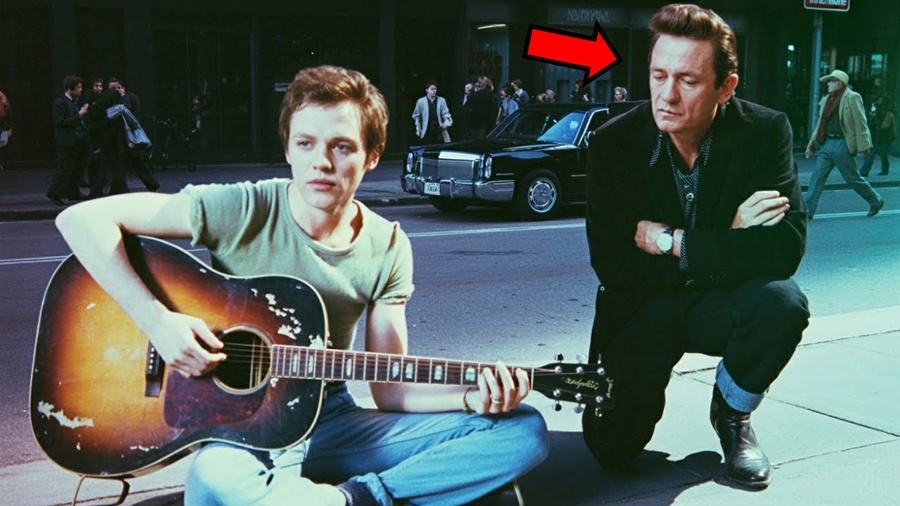
Broke Teen Was Playing “I Walk the Line” on the Street When Suddenly Johnny Cash Showed Up
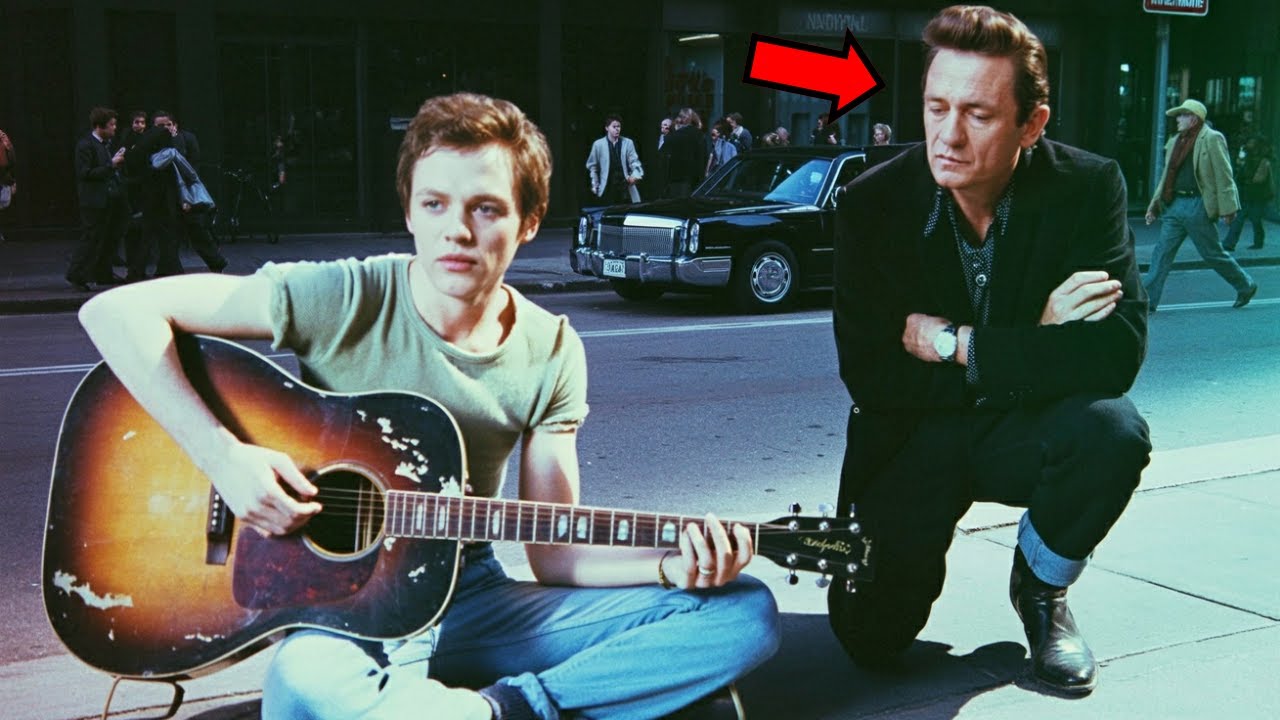
On Nashville’s Broadway, in the hottest hours of the afternoon, 19-year-old Marcus Webb sat playing I walked the line on his worn out guitar. And nobody was watching. Tourists passed by. Men in cowboy hats walked past. Women hurried along with shopping bags. But no one, not a single soul on that corner under that burning sun, gave a second glance to the kid drenched in sweat, pouring his heart into a song, until a black Cadillac slowly pulled to a stop at the end of the street.
The man who stepped out wore a black shirt, black pants, and cowboy boots. His face was familiar but tired. Johnny Cash, the legend. And in that moment, Marcus’s life was about to change forever. But he didn’t know it yet because his eyes were closed. He was so lost in the song that he’d forgotten the world existed.
And that’s exactly why Johnny Cash had stopped. Marcus had been sitting there for 4 hours. The battered hat in front of him held only $6.15. It wasn’t enough. It was never enough. But he couldn’t stop because playing guitar for Marcus was like breathing. It was the only way he could still hear his mother’s voice.
Sarah Webb had died of cancer eight months ago. In her final days, she told Marcus only one thing. Don’t give up the music, baby. Music is the thread that ties you to me. Don’t let that thread break. Marcus was keeping that promise every day, every hour, relentlessly. Because after losing his mother, music was all he had left. Marcus’ story was really a story of collapse. He had no father, never had.
His mother Sarah had raised him alone. She worked cleaning jobs, rich people’s houses. She’d leave at 6:00 in the morning, come home at 10 at night, exhausted, worn down, but she’d always smile at Marcus. “What did you learn today, baby?” she’d ask. Marcus would tell her about school, about books, about his dreams, and Sarah would listen. She always listened.
Then one day, Sarah noticed a lump in her breast. She didn’t have money to see a doctor, but Marcus insisted. When they finally went, the cancer was already stage three. It took 11 months. For 11 months, Marcus held his mother’s hand, sang her songs, tried to make her laugh, but the light in Sarah’s eyes dimmed a little more each day.
On her last day, Marcus had played I walked the line for her. Sarah had closed her eyes and listened. “You’ll keep playing, won’t you, Marcus?” she’d asked. Through his tears, Marcus had promised he would. Now here he was on Broadway, motherless, broke, but with the guitar, that old harmony guitar, the only inheritance Sarah had left him.
It was a cheap guitar, a 1972 model bought from Sears. Marcus had thought about selling it. Maybe they’d give him $50. $50 meant food for a week. But every time he put his hands on that guitar, he felt his mother’s hands. That’s why he couldn’t sell it. And he wouldn’t, even if he starved to death. Johnny Cash stood across the street watching Marcus. His arms were folded.
There was an expression on his face. Recognition? Pain? Maybe both. Johnny looked at this kid and saw years gone by. The 1950s, Memphis. He’d been a kid like this once, poor, hungry, but full of music. After his brother Jack died, Johnny had sat on corners like this, too, singing songs.
Nobody had looked at him either, but he’d played anyway, because music was the only way to quiet the pain. Now at 51, famous but tired, he saw himself in this boy. When Marcus finished the song, he opened his eyes. He was breathing hard. His throat was bone dry. thirst had cracked his lips. He looked at the money in his hat.
Still $6.15. Nobody had dropped anything in the last hour. A voice inside him said, “Give it up, Marcus. This ain’t going to work.” But another voice, his mother’s voice, said, “One more time, baby. Play it one more time.” Marcus took a deep breath. He pulled the guitar back into his lap. His fingers achd, but he didn’t care.
He was about to start I walked the line again, but then he heard a voice. Deep, rough, but gentle. Son, where’d you learn that song? Marcus looked up. Johnny Cash was standing right there in front of him. Marcus’s heart nearly stopped. This couldn’t be real. Johnny Cash here talking to him. Words wouldn’t come.
Johnny smiled, a small, tired smile. Don’t be scared, son. I’m just asking. You play that song real good, but you play it like you’ve lived it. Marcus finally managed to speak. His voice cracked. My mama taught me. She loved you. She listened to your songs every day. That’s how I learned. Johnny’s face changed. The smile disappeared.
Something heavy settled in his eyes. Where’s your mama now? He asked. Marcus lowered his head. Tears were coming, but he tried to hold them back. She died eight months ago. Cancer. Johnny nodded slowly. For a while, he didn’t say anything. He just looked. Then he crouched down beside Marcus. His knees cracked.
His 51-year-old body was full of pain from the pills from the years, but he didn’t care. He looked at the guitar, the old harmony. Neck bent, varnish peeling. This from her? He asked. Marcus nodded. It’s all she left. I thought about selling it, but I can’t. If I sell this guitar, it feels like I’d be losing her all over again.
Johnny touched the guitar. His fingers moved lightly over the strings. The guitar was old, but it had been cared for. There was love in it. This guitar ain’t just a thing to you, Johnny said. This is your mama’s voice, and right now it’s your voice, too. Don’t you sell it, son. Don’t you dare.
Marcus’s eyes filled with tears. “This man, this legend,” understood him. “Oh, but I got no money,” Marcus said. “Can’t pay my rent. Can’t buy food. How can I not sell it?” Johnny stood up. He pulled out a stack of bills from his pocket. Didn’t even count them. Dropped them all into Marcus’s hat. Maybe $300, maybe more. Marcus was frozen, stunned. No, sir.
I don’t want charity. I Johnny raised his hand, stopping him. This ain’t charity, son. This is a debt. Years ago in Memphis, I was just like you. Hungry, broke, but full of music. A man helped me. I asked him, “How can I thank you?” He said, “One day you help somebody else. Now it’s my turn, and one day it’ll be yours. Don’t forget that.
” Marcus was crying, uncontrollably crying. Johnny looked at him. There was determination in his face. Now listen to me. Tomorrow morning at 10:00, be at the back door of the Ryman Auditorium. Bring your guitar. We’re going to do something together. Marcus couldn’t believe it. What are we going to do? Johnny smiled.
We’re going to remind the world what real music is. That night, Marcus couldn’t sleep. He’d gotten a room at a cheap motel. Spent $18 of the money Johnny had given him. The room was small, smelled of mildew, but it had a clean bed. Marcus laid down and let his mind wander. Johnny Cash was going to meet him tomorrow at the Ryman Auditorium. This was impossible.
These kinds of things didn’t happen to kids like Marcus Webb, but the money in his pocket was real. The dried tears on his face were real. Marcus held his mother’s guitar close and kept holding it until his eyes finally closed. For the first time in months, he slept peacefully. The next morning, Marcus woke at 8:30.
He panicked. Was he late? No, it was only 8:30. The Ryman was at 10:00. He walked there. Didn’t want to spend money on a bus. Took about 40 minutes. His feet achd. His shoes were old. The souls had holes. But he didn’t care. When he saw the Ryman, he stopped. The historic building. They called it the Mother Church of Country Music.
Legends had walked that stage. Hank Williams, Paty Klene, Johnny Cash, and now Marcus Webb, 19 years old, broke nobody, was about to walk inside. He found the back door. A security guard stood there, middle-aged, heavy, tired-l looking man. Marcus walked up. His voice trembled. Excuse me. Johnny Cash asked me to come here.
The guard looked down at him. Sure, sure. Johnny Cash asked you to come. I get five of you every day. Move along, kid. Marcus should have expected this. Nobody would believe him. Please, he said, I’m telling the truth. Yesterday, I was singing on Broadway. He saw me, talked to me, told me to come here. My name is Marcus Webb.
The guard frowned, half skeptical, half curious. Marcus Webb, huh? Hold on. The man spoke into his radio, muttered something, then waited. 30 seconds of silence. Marcus’s heart was pounding. What if Johnny forgot? What if he was just being polite? But then a voice came through the radio. Send him in. The guard’s face changed. Surprise, then respect.
You can go in, kid. Straight ahead. Turn left. Third door. Marcus breathed. Thank you, he said, and stepped inside. The ceiling was high. Old posters hung on the walls. Photos of legends. Marcus walked, turned left, found the third door. He raised his hand and knocked three times. That familiar voice came from inside.
Come in. When Marcus opened the door, Johnny Cash was there. But this time was different. This wasn’t stage Johnny. This was home Johnny. Black t-shirt, jeans, a cup of coffee in his hand. The room was simple. A few chairs, a table, a guitar stand in the corner. Johnny smiled. A real warm smile. So, you came. Good. Sit down, Marcus. Marcus sat.
His hands were shaking. He held his guitar in his lap like a shield. Johnny looked at him for a long time. His eyes studied Marcus’s face, his hands, his guitar. Then he spoke. Marcus, I’m going to ask you something, and I want you to be honest. What do you want to do with music? You want to be famous, make money, or is it something else? Marcus thought about it.
Nobody had ever asked him that question before. I I just want to play, Marcus said. Since my mama died, music’s my only friend. I don’t want to be famous. I just I just want to keep the music alive. Johnny nodded. Good answer. Because Marcus, the music industry will eat you alive. It’ll change you. Turn you into a product. I’ve lived it.
My career hit rock bottom. Right now in 1984, I’m a hasbin. I’m old-fashioned. Radio won’t play me. Columbia Records doesn’t care about me. But you know what? I don’t care because I still believe in music. Real music. So do you. And that’s why I’m going to do something with you. Now play for me. Whatever you want, but play the truth.
Put your soul in it. Marcus held his guitar, placed his fingers on the strings. What should he play? I walked the line. No. Johnny had heard that song a hundred times. Something else. Then it came to him. A melody he’d written after his mother died. No words, just chords, just feelings. A simple melody. M FCG. Over and over.
But with each repetition, he added something. Pain longing. He started playing. His fingers danced across the strings. The guitar was crying, crying for Marcus. The melody ended. The room was silent. Johnny took a sip of his coffee. set the cup down on the table. That’s it, he said. That’s real music. Marcus, your technique’s weak.
Your chords are simple, but your heart’s full. And in music, that’s what matters most. Now, we’re going to do something together. Johnny picked up his own guitar. A black Martin legendary guitar. I’m going to play with you, he said. You play that melody. I’ll follow. Let’s see what happens. Marcus started again. AMFCG. Johnny listened.
The first round he just listened. The second round he touched his guitar. Light supportive cords. The third round he joined in fully. Two guitars became one. The old legend and the young kid. Two generations, two pains meeting in one song. Johnny had closed his eyes. He was adding a new dimension to Marcus’s melody. The simple chords grew richer in Johnny’s hands.
But Marcus’ soul didn’t get lost. It was there in every note. The melody ended. Both guitars fell silent. Johnny opened his eyes. They were wet, but he wasn’t crying. Marcus, he said, I’m going to tell you something, and I want you to take it serious. You got talent. Not great talent, but real talent.
And real beats great every time. Now, I’m going to make you an offer. Next week, I got a small show in Knoxville, a bar, 300 people, old fans. I’m putting you on that stage. You’re going to play with me. The world’s going to see you. You in? Marcus’ world spun the stage. A concert with Johnny Cash. This couldn’t be real. I I’m not ready, he said.
I’m not a professional. People will boo me. Johnny laughed. A deep rough laugh. They going to boo you? Maybe. But you won’t care because you ain’t playing for them. You’re playing for the music. Marcus, I’ve been on stage for 30 years. People loved me, then they hated me, then they forgot me.
But I kept playing because music’s bigger than me. You’re going to do the same next week, Knoxville. Be ready. Marcus cried, deep sobbing cries. Johnny moved closer, put his hand on his shoulder. Cry, son. Your tears are your strength. Your mama’s watching, and she’s proud. For a week, Marcus rehearsed with Johnny. He came to the Ryman every morning.
Johnny didn’t teach him technique. He just listened. “Listen to your heart,” he’d say. “Your fingers will follow.” Marcus grew stronger every day. Not just in his music, but in his soul. He wasn’t sitting on the street with his guitar anymore. Now he had a purpose. Johnny chose the song they’d play at the Knoxville show.
I walked the line. But that’s your song, Marcus said. No, Johnny said. Now it’s our song. The night of the concert came. The bar in Knoxville was packed. 300 people, mostly older folks, Johnny Cash fans. When Johnny walked on stage, applause broke out. But it wasn’t wild applause. It was polite.
Because in 1984, Johnny Cash wasn’t as popular as he used to be. Johnny stepped up to the microphone. Good evening, folks. Tonight, I want to introduce you to somebody special. A week ago, I found this young man on Broadway. He was playing his guitar, singing. He was broke. He had nobody, but he was full of music. Tonight, he’s going to play with me.
Please welcome Marcus Webb. Marcus walked on stage. His legs were shaking. 300 pairs of eyes watching him. The applause was scattered. People were skeptical. Who is this kid? Why is he on stage? Marcus held his guitar, looked at Johnny. Johnny nodded. Go ahead, son. Marcus took a breath, and he started playing. I walked the line.
Simple chords he played. He sang. His voice cracked, but it was honest. And slowly the bar went quiet. People started listening. Johnny picked up his guitar, joined Marcus. Two voices became one, young and old, past and future. When the song ended, the bar stood up. The applause was loud, genuine, long.
Marcus was crying on that stage. Johnny put his arms around him. That’s it, son. That’s real music. Years later, Marcus Webb played in small clubs. He never got famous, but in every city, there were people who came to hear him. And at every show, he’d play I walked the line. this song, he’d say, “Johnny Cash taught me. But more important, my mama taught me.
” When Johnny Cash died in 2003, Marcus was at the funeral. He brought his guitar and at the graveside one last time, he played I walked the line. Tears fell on the guitar. “Thank you,” he whispered, “for teaching me what music really means.