A Salesman Told Johnny Cash He Couldn’t Afford a Cadillac — Then Cash Pulled Out $8,000 in Cash
A Salesman Told Johnny Cash He Couldn’t Afford a Cadillac — Then Cash Pulled Out $8,000 in Cash
[music] The Cadillac salesman looked at Johnny Cash’s dusty cowboy boots and saw a man who couldn’t afford the gas to fill the tank, let alone the car itself. What happened in the next 45 minutes would become one of the most legendary stories ever told about the man in black. But here’s what nobody talks about.
It wasn’t about the money. It wasn’t about proving a point. It was about a promise Johnny had made to June Carter three months earlier. A promise that involved a hospital bed and three words that changed everything. November 14th, 1968. Memphis, Tennessee. Madison Cadillac dealership on Union Avenue, just six blocks from Sun Records, where Johnny Cash had recorded his first hit 13 years earlier.
The morning was cold, gray, the kind of Tennessee November that seeps into your bones. Johnny pulled his beat up 1962 Jeep into the parking lot and sat there for a moment looking at the gleaming rows of brand new Cadillacs. White ones, black ones, and that particular shade of powder blue that June loved so much. He hadn’t slept much the night before.
Every time he closed his eyes, he saw June’s face in that hospital bed 3 months ago, August 19th, 1968. complications from a surgery that was supposed to be routine. Johnny had sat in that waiting room for 11 hours, bargaining with God the way only a desperate man can bargain. And somewhere in those 11 hours, he made a promise. June had mentioned once that she’d always wanted a powder blue Cadillac convertible.
Said her daddy drove one when she was a little girl back when the Carter family was touring the South. Said it made her feel like royalty. Johnny had filed that away in his memory. And sitting in that hospital waiting room, not knowing if his wife would live or die, he swore that if she made it through, he would buy her that Cadillac. Now it was November.
June was healthy again, and Johnny Cash was about to keep his promise. He stepped out of the Jeep and looked down at himself. Dusty black jeans, scuffed cowboy boots, a faded denim jacket over a black shirt. His hair was longer than usual, uncomed. He looked like a ranch hand who’d wandered into the wrong part of town.
But Johnny didn’t care about appearances, never had. He’d grown up picking cotton in Das, Arkansas, wearing clothes handed down from his older brothers. The fancy suits came later, but they never felt like him. The showroom was impressive. Polished floors you could see your reflection in. Crystal chandeliers and cars.
beautiful elderorado and devils, each one gleaming under the lights like a promise of a better life. A voice interrupted his thoughts. Can I help you, sir? Johnny turned to see a young salesman approaching, maybe 25, wearing a suit that probably cost more than Johnny’s entire outfit. His smile was the kind salesman practiced in mirrors.
But something in that smile faltered when he got a good look at Johnny. His eyes traveled from the dusty boots to the faded jeans to the uncomebed hair. “This was not,” the salesman’s expression said, “a serious customer.” “Richard Hartwell,” the salesman said, shaking Johnny’s hand with obvious reluctance. “Welcome to Madison Cadillac.
” “Are you here to look, or is there something specific I can help you find?” The way he emphasized look made his meaning clear. Looking was free. Looking was something anyone could do. even a dusty cowboy who clearly couldn’t afford a bicycle. Actually, Johnny said, his voice that familiar low rumble. I’m looking to buy for my wife.
She’s partial to powder blue. Convertible if you’ve got one. Richard’s eyebrows rose. Powder blue convertible. That would be our Elorado model. Starting price is 7,200. Johnny nodded. 7,200. That include the tax? Richard’s smile tightened. Sir, I don’t mean to be presumptuous, but our Elorado is a premium vehicle.
Perhaps I could show you something more accessible. Something in the used section, maybe. Johnny felt a familiar sensation in his chest. Not anger, disappointment. He dealt with people like Richard his whole life. People who judge the cover without bothering to read the book. But he’d learned something important over the years.
You could waste your energy fighting people like this, or you could simply prove them wrong. I appreciate the concern, Johnny said pleasantly, but I think the Elorado will suit just fine. Richard led him to the back corner where three Elorado convertibles sat. One red, one white, one powder blue. Johnny walked straight to the blue one.
This is the one, he said quietly. 7,450 with options, Richard said. plus tax, title, and registration. Just under 8,000 allin, he paused. We do offer financing, of course, for qualified buyers. The emphasis on qualified was impossible to miss. How soon can I drive it off the lot? Johnny asked. Richard actually laughed.
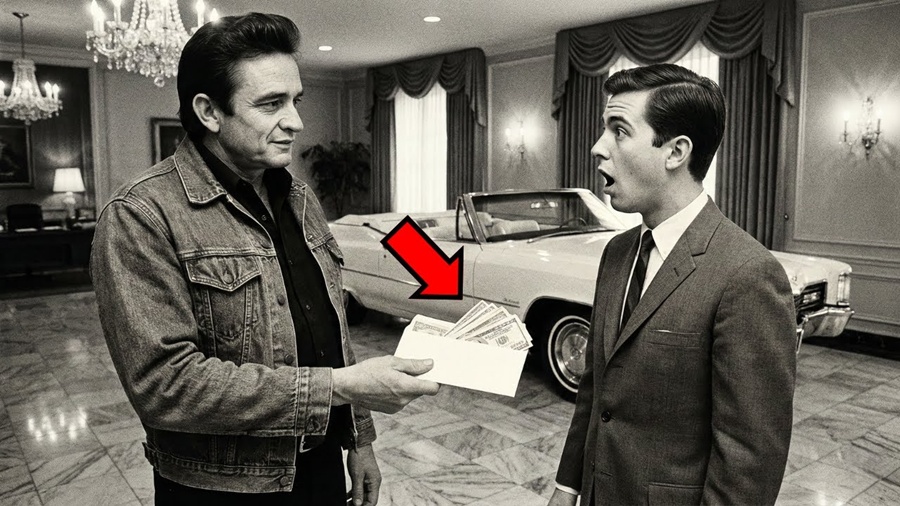
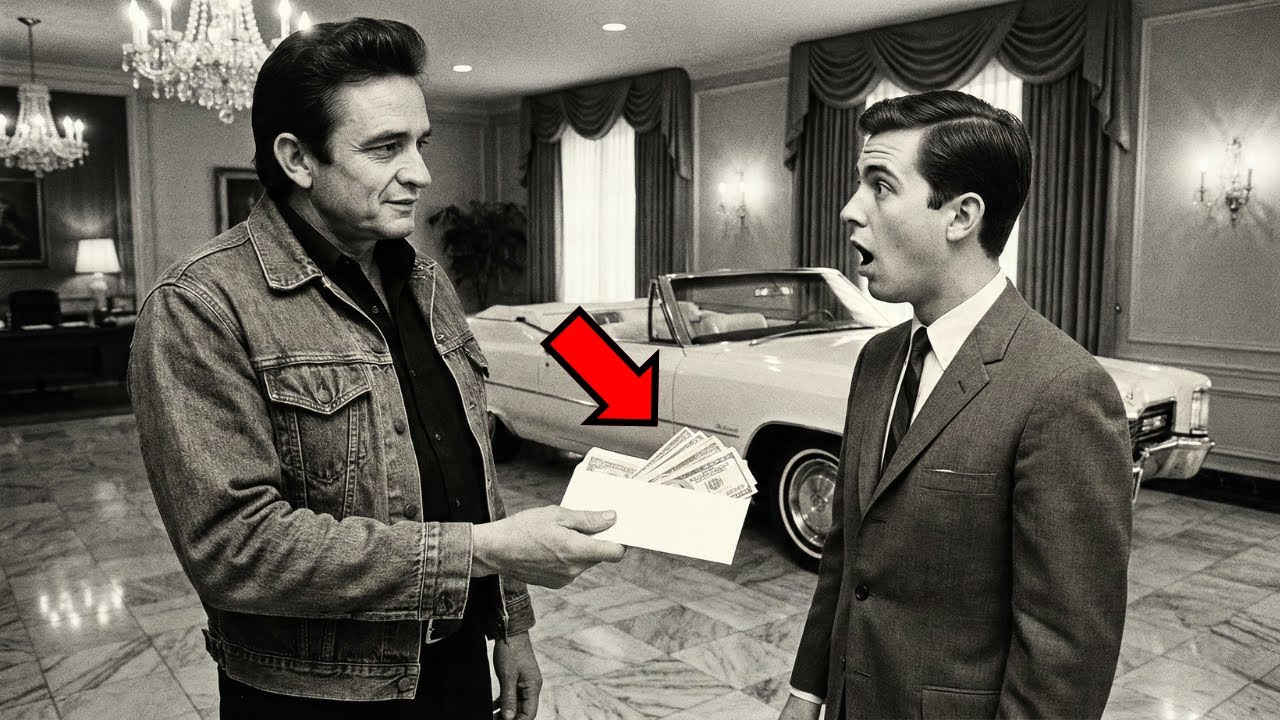
A short, disbelieving sound. Well, sir, that depends on financing approval. Credit check, employment verification could take a few days. Johnny reached into his jacket and pulled out an envelope. He’d stopped at the bank that morning. The envelope was thick with $100 bills, 80 of them. “I was thinking cash,” Johnny said simply. “That’s 8,000 even.
” Richard’s hand started to shake as he opened the envelope. “Sir, I This is Where did you?” A manager emerged from a back office. “Is there a problem here?” Richard looked at his boss, then at Johnny, then at the cash. This gentleman wants to buy the powder blue El Dorado cash. $8,000. The manager’s demeanor changed instantly. His smile became genuine.
Welcome to Madison Cadillac. I’m Thomas Crawford. May I ask your name, sir? Cash, Johnny said. Johnny Cash. The silence was deafening. Crawford’s face went pale. Richard’s mouth dropped open. The Johnny Cash? Crawford asked. Johnny shrugged, that crooked smile appearing. That’s what my mama named me.
Crawford turned to Richard with fury in his eyes. Do you know who you’ve been talking to? This is the man who recorded at Folsam Prison, the album that’s been number one for 6 months. And you showed him the used section. Richard looked like he wanted the floor to swallow him. Mr. Cash, I am so sorry.
If I’d known who you were,” Johnny held up his hand. “That’s the thing,” he said quietly. “You didn’t know who I was. You just saw a man in dusty boots who didn’t look like he belonged, and you treated him accordingly.” He paused. “But here’s what I’ve learned. Every man who walks through that door deserves the same respect, whether he’s got $8 or $8,000.
You never know someone’s story just by looking at them.” The showroom was still. Even the phones had stopped ringing. But Johnny wasn’t finished because what he said next to young Richard Hartwell would turn this awkward moment into something people would talk about for decades. Johnny looked at Richard Hartwell for a long moment.
The young salesman was sweating now, his expensive suit suddenly looking like a costume he’d borrowed from someone else. His earlier arrogance had evaporated completely, replaced by the desperate expression of a man who knew he’d made a terrible mistake. But instead of anger, Johnny felt something else. Recognition.
He saw himself in this young man. Not the arrogance, but the fear underneath it. The need to prove something. The desperation to be somebody in a world that kept telling you that you weren’t enough. Johnny had felt that same desperation in his early 20s when he was selling appliances doortodoor in Memphis, getting doors slammed in his face day after day.
He’d learned to judge people quickly back then, too. You had to just to survive. Sometimes you got it wrong, “Son,” Johnny said, his voice low enough that only Richard could hear. “How long you been working here?” Richard swallowed hard. “3 months, sir?” Johnny nodded slowly. Let me guess. You got a wife at home? Maybe a baby on the way? Richard’s eyes widened.
How did you? Johnny smiled, but there was no mockery in it. Because I’ve been where you are, trying to make something of yourself. Trying to prove you belong. And when you’re that hungry, you start making calculations. You look at a man’s boots and you decide he’s not worth your time because your time is precious and you’ve got bills to pay.
Richard’s face crumpled. “Mr. Cash, I’m so sorry. I didn’t mean.” “I know you didn’t,” Johnny said. “That’s why I’m not angry.” He reached into his pocket and pulled out a smaller envelope. Inside was another $500 in cash. “This is for you,” Johnny said, pressing it into Richard’s hand. “Not because you earned it, but because I remember what it’s like to be young and scared and trying to make ends meet.
” Richard stared at the money, then at Johnny, his eyes filling with tears. I can’t accept this, sir. I treated you terribly. Johnny put his hand on the young man’s shoulder. Then let it be a lesson, he said. Next time a man walks in here looking like he doesn’t belong. You treat him like he’s the most important customer you’ve ever had. Because maybe he is, or maybe he isn’t.
But either way, he deserves your respect. That’s something my mama taught me back in Arkansas, and it’s never steered me wrong. Thomas Crawford, the manager, had been watching this exchange with growing amazement. He’d expected Johnny Cash to demand Richard’s termination. He’d expected fury, threats, the kind of behavior he’d seen from wealthy customers over far smaller slights.
Instead, he was watching one of the most famous men in America give money to the salesman who had insulted him. Mr. Cash, Crawford said carefully. I want you to know that this kind of treatment is not representative of Madison Cadillac. I assure you there will be consequences for Johnny held up his hand. There won’t be any consequences, he said firmly.
This young man made a mistake. We all make mistakes. What matters is what we do after. He turned back to the powder blue El Dorado, running his hand along the chrome trim one more time. now,” he said, his voice returning to its usual easy cadence. “About this car. My wife’s birthday is in 2 weeks. I’d like to have it delivered to our home in Hendersonville with a big red bow on it.
Can you arrange that?” Crawford nearly tripped over himself, agreeing. “Absolutely, Mr. Cash. We’ll have it detailed, fully serviced, and delivered personally on the house. The delivery, I mean the car itself.” Johnny waved his hand. The 8000 covers it. Keep whatever’s left over for your trouble. He paused, then added with a slight smile.
And maybe use some of it to train your salesman on customer service. Just a thought. Crawford’s face reened, but he nodded vigorously. Of course, Mr. Cash. Thank you for your understanding. Johnny signed the paperwork in the manager’s office while Richard Hartwell stood in the corner, still clutching the envelope of cash like he wasn’t sure it was real.
When everything was complete, Johnny shook Crawford’s hand and turned to leave. But at the door, he stopped and looked back at Richard. “One more thing,” Johnny said. “That wife of yours. The one with the baby on the way.” Richard nodded, not trusting his voice. You take care of them, Johnny said. Because at the end of the day, that’s all that matters.
Not the cars, not the money, not the fancy suits, just the people who love you and the people you love back. Everything else is just noise. He pushed through the glass doors and walked out into the cold November morning, leaving behind a showroom full of people who would tell this story for the rest of their lives.
Two weeks later, on November 28th, 1968, a powder blue Cadillac Elorado convertible with a giant red bow on top was delivered to the cash residence in Hendersonville, Tennessee. June was in the kitchen when she heard the truck pull up. She walked outside, still wearing her apron and stopped dead on the front porch.
Johnny was standing next to the car, grinning like a kid on Christmas morning. Happy birthday, darling,” he said. June’s hand flew to her mouth. Johnny, she whispered. You didn’t. I did, he said. You told me once about your daddy’s powder blue Cadillac. How it made you feel like royalty. I figured it was time you felt that way again.
June walked slowly down the porch steps, her eyes never leaving the car. When she reached it, she ran her fingers along the hood the same way Johnny had done in the showroom two weeks earlier. It’s beautiful, she said, her voice breaking. But Johnny, we can’t afford. We can afford whatever makes you happy, Johnny said. He pulled her into his arms.
When you were in that hospital bed, I made a promise. I told God that if he let you live, I’d spend the rest of my life making sure you knew how much you meant to me. This car is just the beginning. June looked up at him, tears streaming down her face. Johnny Cash, she said, “You’re the most impossible, stubborn, wonderful man I’ve ever known.
And I love you more than that car, more than anything.” She kissed him then, right there in the driveway, with the November wind blowing and the powder blue Cadillac gleaming in the afternoon sun. It was the kind of moment that songs are written about and Johnny would write one eventually.
But right then, in that moment, words didn’t matter. Only the feeling did. The story of what happened at Madison Cadillac spread through Memphis like wildfire. Within a month, everyone in the music industry had heard some version of it. The details changed with each telling, as stories do. Some said Johnny had walked in barefoot. Others claimed he’d been covered in mud from head to toe.
A few versions had him arriving on horseback, but the core of the story remained the same. Johnny Cash had been judged by his appearance and found wanting, and instead of responding with anger, he’d responded with grace. Richard Hartwell kept that $500. He used it to pay for his wife’s hospital bills when their daughter was born 3 months later.
and he never forgot the lesson Johnny Cash had taught him that November morning. 20 years later in 1988, Richard was the general manager of that same Cadillac dealership. He’d worked his way up from the showroom floor, treating every customer who walked through the door like they were the most important person in the world.
On his office wall hung a frame photograph. It showed a young salesman standing next to a powder blue El Dorado shaking hands with a tall man in dusty cowboy boots. Underneath the photo in simple handwriting were the words that Richard had lived by ever since. Every man deserves respect. You never know someone’s story just by looking at them.
Johnny Cash had signed it. And every morning before the dealership opened, Richard would look at that photo and remember the day the man in black taught him what it really meant to see people. Not their clothes, not their cars, not their bank accounts, just their humanity. That was Johnny Cash’s real gift. Not the music, though the music was extraordinary.
Not the fame, though the fame was undeniable. It was his ability to see people for who they really were underneath all the dust and struggle and pretense. He’d learned it picking cotton in Arkansas. He’d refined it playing for prisoners at Folsam. And he demonstrated it in a Cadillac showroom in Memphis on a cold November morning when he could have crushed a young salesman’s career, but chose to change his life instead.
June drove that powder blue El Dorado for 15 years. She said it was the best gift Johnny ever gave her. But Johnny knew the truth. The real gift wasn’t the car. It was the promise he’d kept. And the reminder that love, real love, isn’t about grand gestures or expensive things. It’s about showing up day after day and proving that you meant every word you ever said.